
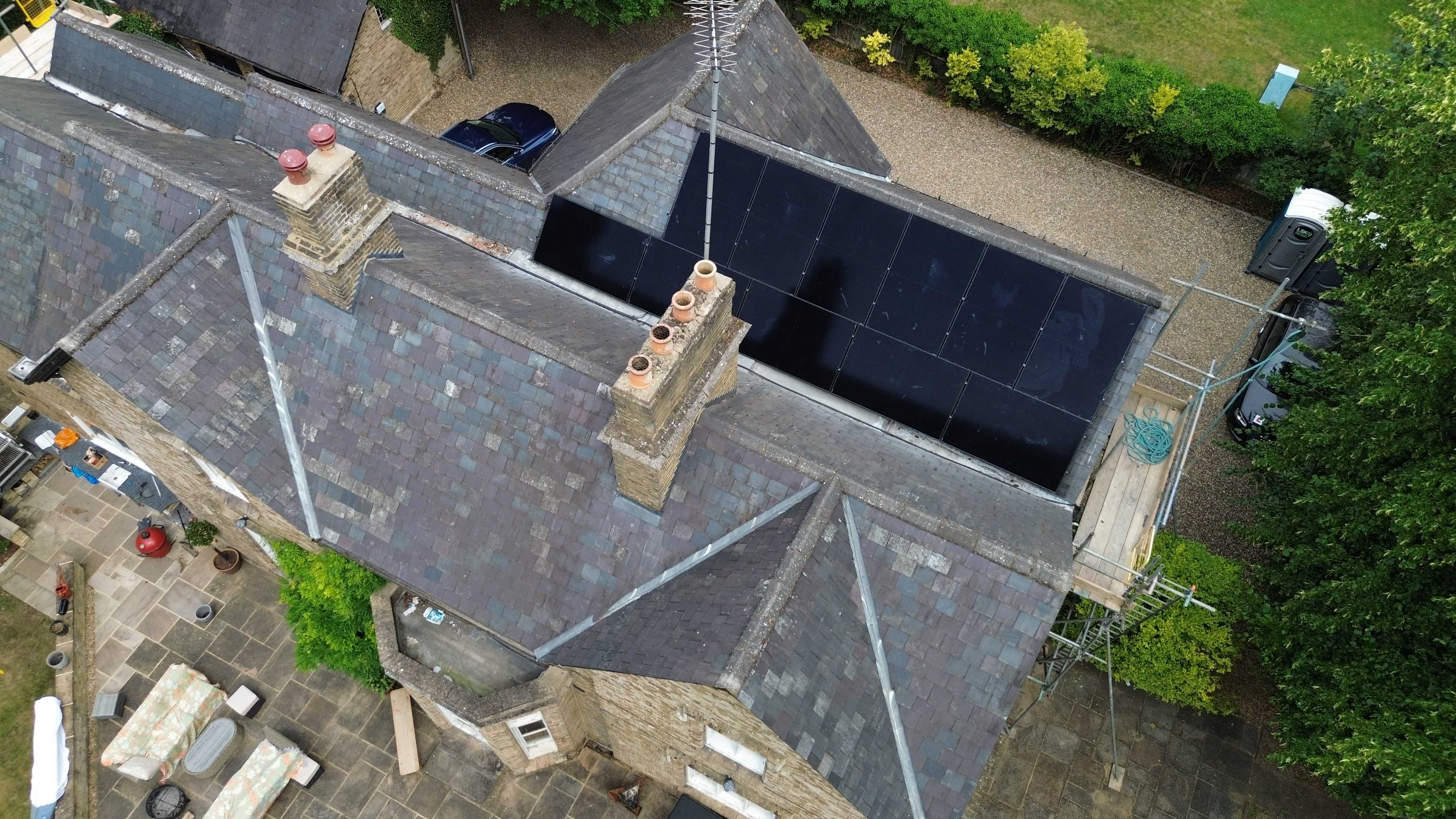
Solar Panel Installation
in Hertfordshire & North London
Local, MCS-certified solar panel installers based in St Albans. Survey, design, grid notification, fit and commissioning, with your MCS certificate issued on completion.
Solar panel installation: the quick answer
A solar panel installation is a roofing job, an electrical job and a paperwork job at the same time, and most quotes only describe the first two. This page sets out all three: what physically happens to your roof, what an installer is obliged to put in writing before and after, and what it costs while the 0% VAT rate runs to 31 March 2027. SOLA UK Ltd is an MCS-certified installer at Arquen House, 4-6 Spicer Street, St Albans AL3 4PQ, working across Hertfordshire, North London and the surrounding area.
Every figure below is sourced and the source is named beside it. Where a number depends on your own roof - generation, self-consumption, price - we say so rather than printing an average and calling it a quote. For the national picture, including 2025/26 cost data by system size and typical timescales, see our solar panel installation guide for the UK. If you would rather talk it through, call 0800 470 0922.
What a solar panel installation includes, end to end
A compliant domestic solar panel installation is governed by one document: MIS 3002, The Solar PV Standard (Installation). Issue 6.0 was published on 18 March 2026 and compliance became mandatory for certified contractors on 18 June 2026. It covers systems supplying permanent buildings and connected in parallel to the electricity distribution network up to a maximum DC output of 50 kWp, which is every domestic roof and most small commercial ones.
The sequence the standard imposes is more specific than the three-step process most installer sites describe. Before a contract is awarded you must receive a generation estimate calculated by the method in Appendix B of the standard, plus a self-consumption estimate calculated in line with MCS guidance document MGD 003. Before work starts, the building has to be assessed by a competent professional experienced in solar photovoltaic systems, to confirm it is suitable and that the installation will not compromise the building's compliance with the Building Regulations. After commissioning, the system is inspected and tested in line with the IET Code of Practice for Grid Connected Solar Photovoltaic Systems, the network operator is notified, a document pack is collated and explained to you, and the installation is registered on the MCS Installation Database so a certificate can be generated.
On our own jobs the kit is AIKO 485W all-black panels, with SigEnergy batteries or a Tesla Powerwall 3 - a 13.5 kWh unit rated at 11.5 kW continuous - where storage is part of the design. SOLA UK is MCS certified, a RECC member, TrustMark registered and an OZEV approved installer, and covers solar PV, battery storage and EV chargers on both domestic and commercial properties.
- Building assessment by a competent professional, confirming suitability and that Building Regulations compliance is not compromised
- Design, plus the MCS generation estimate and a self-consumption estimate, in writing before you sign
- Mounting system, modules, inverter and AC connection, installed in line with the IET Code of Practice
- Commissioning to a documented procedure, with inspection and test records retained
- Network operator notification by the contractor, on the G98 or G99 route
- A collated document pack, explained at handover, with a signed declaration
- Registration on the MCS Installation Database and an MCS certificate sent to you
Who is responsible for which piece of paperwork
This is the part no page in the current top three covers, and it is the part that goes wrong. Up to four separate notifications can apply to one domestic installation, and they have different owners and different deadlines.
Network notification is the installer's job, not yours. MIS 3002 clause 5.1.9 places notification to the Distribution Network Operator on the MCS contractor. Which route applies depends on current, not on kilowatts: EREC G98 covers installations up to and including 16 A per phase, and EREC G99 applies above that. The Energy Networks Association puts 16 A per phase at 3.68 kW on a single-phase supply and 11.04 kW on a three-phase supply, measured as the aggregate capacity installed at the premises. On the G98 route the ENA is explicit that you do not need to talk to the network operator before the equipment is up and running, and that your installer must notify within 28 days of commissioning - it calls that a legal requirement. Above 16 A per phase, G99 approval comes before installation, which is the step that can move a start date by weeks.
The aggregation rule catches people out. MIS 3002 notes that the 16 A threshold is the total aggregated AC output of all generators, and gives the worked example of a 3 kW solar PV system plus a 3 kW battery storage system on the same single-phase supply exceeding it, so G99 applies. The ENA's own definition of a micro-generator says in terms that it includes electricity storage devices. Adding a battery is therefore the most common reason a straightforward job becomes a G99 job.
Hertfordshire sits in the Eastern England distribution area and North London in the London area, and the ENA's Distributor ID table shows UK Power Networks for both. You can confirm yours from the Distributor ID at the start of the MPAN on your electricity bill - the ENA makes the point that your network operator is not the same company as your energy supplier.
Building control is the notification most quotes are silent on. Where the work is notifiable under the Building Regulations, MIS 3002 clause 5.1.6 requires the installer to make clear to you who is responsible for that notification. Clause 5.1.7 requires the installer, where they are responsible, to complete it before handing the installation over, and permits self-certification in place of building control approval only where the installer is registered with a Competent Persons Scheme approved for the work in question. Ask which applies to your job, and get the answer in writing.
The MCS certificate is generated by the contractor, not by you. The installation must be registered on the MCS Installation Database no later than 10 working days after commissioning, and the resulting certificate is sent to you with instruction to include it in your handover pack. Registration can only happen once the system is fully installed and commissioned, never before. Smart Export Guarantee registration is then yours to do, with a supplier of your choosing, using that certificate.
- Network operator notification - the MCS contractor. G98: within 28 days of commissioning. G99: approval before installation
- Building Regulations notification - whoever the contract says, and the installer must tell you which it is before the work
- MCS Installation Database registration and certificate - the MCS contractor, no later than 10 working days after commissioning
- Smart Export Guarantee registration - you, with your chosen supplier, using the MCS certificate
- Planning or prior approval where it applies - checked at design stage; the installer must make you aware of every permission needed
What solar panel installation costs, and the VAT date that moves the number
The honest national benchmark is the Energy Saving Trust's. Its solar panel advice page, last updated 1 October 2026, states that domestic solar panel systems are generally around 4.5 kWp and cost around 7,600 pounds, that a 4.5 kWp system typically covers between 20 and 30 square metres of roof using around 12 panels, and that battery storage tends to cost around 5,000 to 8,000 pounds. Those are averages for Great Britain, not a quote for your roof, and we have not dressed them up as one.
VAT is the one lever with a hard date on it. In Great Britain the installation of certain specified energy-saving materials has been zero-rated since 1 April 2022, and HMRC's VAT Notice 708/6 states that the zero rate runs to 31 March 2027 and that from 1 April 2027 onwards these will revert to the reduced rate of VAT of 5%. Solar panels are listed as including photovoltaic panels with cabling, control panel and AC/DC inverter, and electrical storage batteries installed in residential accommodation have qualified for the temporary zero rate since 1 February 2024. The zero rate applies to labour as well as equipment, and the reversion is to 5%, not to 20%.
There is no grant to wait for. The Energy Saving Trust states that there are no dedicated government grants for solar panels in the UK at the moment, while noting that the position may change as details of the Warm Homes Plan emerge. Anyone promising you a solar grant today is describing something else.
What actually moves a real price is the roof, not the panel brand: scaffolding and access, tile type and condition, whether the array splits across two slopes, cable run length to the consumer unit, inverter choice, and whether storage is in scope. We price per roof after the assessment, and the written quote shows the VAT position on its face. One consumer-code point is worth knowing before you pay anything: RECC tells consumers to make sure they are not required to pay more than 25% of the final contract price as a deposit.
- Energy Saving Trust benchmark: around 4.5 kWp, around 7,600 pounds; around 12 panels over 20 to 30 square metres
- Battery storage, Energy Saving Trust: around 5,000 to 8,000 pounds
- 0% VAT on installation to 31 March 2027, then the 5% reduced rate from 1 April 2027 (VAT Notice 708/6, section 2.1)
- Batteries zero-rated in residential accommodation since 1 February 2024 (VAT Notice 708/6, section 2.19)
- No dedicated UK government solar grant at present (Energy Saving Trust)
- Deposit guidance, RECC: no more than 25% of the final contract price
What a Hertfordshire or North London roof actually generates
Generic national averages are the weakest part of every competing page. The figures below come from the European Commission's PVGIS tool, API v5_3 PVcalc, run for St Albans at 51.7527, -0.3394. The assumptions are stated so you can reproduce them: 4.5 kWp of crystalline silicon, a 35 degree pitch, 14% system losses, building-mounted, using the PVGIS-SARAH3 radiation database covering 2005 to 2023. Change any of those inputs and the output changes.
The spread between orientations is narrower than most homeowners expect. A due-east slope comes out about a fifth below due south here, and due west marginally below east. That is a reason to model your own roof rather than rule it out - and if you use most of your electricity in the morning or the evening, an east or west array can suit your consumption pattern better than a south-facing one. The Energy Saving Trust makes the same point: east-facing panels generate more in the morning and west-facing panels do better in the afternoon and early evening.
Seasonality matters more than orientation. On the due-south run, PVGIS returns about 177 kWh in January against about 541 kWh in June - roughly a threefold swing. Any annual saving figure that glosses over that is hiding how little a winter month contributes.
To turn kilowatt-hours into money you need a price. Ofgem's price cap for 1 October to 31 December 2026 sets the electricity unit rate for a direct debit customer at 26.32p per kWh with a 54.83p daily standing charge, and the cap for that period is 1,723 pounds a year. So each kilowatt-hour you use in the house instead of importing is worth 26.32p at that rate. We have deliberately not multiplied that out into an annual saving, because the answer depends entirely on how much of your generation you use yourself. MIS 3002 requires that self-consumption figure to be estimated for your own household and shown in your quote, and requires the estimate to be accompanied by a caution that solar PV performance cannot be predicted with certainty and should not be treated as a guarantee.
Shading can outweigh all of it. The Energy Saving Trust makes the point that a south-facing roof that is shaded during the day may generate less power than an east- or west-facing roof in full sun, and that where shading is unavoidable an installer may recommend microinverters or power optimisers so that one shaded panel does not drag down the performance of the whole system. A sunpath diagram belongs in your quote whenever shading is present.
Planning permission and permitted development: what the 2026 rules say
Most domestic solar needs no planning application. The Energy Saving Trust puts it simply: in most cases no, because solar panels are permitted development, with listed buildings and homes in conservation areas as the exceptions to check. The detail sits in the General Permitted Development Order, Schedule 2, Part 14, Class A, as amended by S.I. 2026/896, which came into force on 27 August 2026.
For a house with a pitched roof, panels are permitted development where they protrude no more than 0.2 metres beyond the plane of the roof slope and no part of the equipment is higher than the highest part of the roof, excluding any chimney. On a flat roof the limit is 0.6 metres above the highest part of the roof. Those two measurements decide most jobs.
The conservation-area rule is the one most often reported wrongly, including by installers. Within a conservation area the Class A restriction applies to equipment on a wall, a balcony or a roof enclosure that fronts a highway. It does not strip permitted development rights from your roof slopes. If you have been told a conservation area rules out roof panels outright, that is not what the Order says - although the separate condition that equipment be sited so as to minimise its effect on the external appearance of the building applies everywhere.
Two situations genuinely need an application. A flat-roof array on article 2(3) land - conservation areas, National Parks, the Broads, National Landscapes and World Heritage Sites - requires an application to the local authority for a prior approval determination before work starts. And a listed house sits outside Class A altogether, which means the listed building consent route rather than permitted development. Separately, only an Article 4 Direction removes roof-slope rights on an ordinary street, so it is worth checking whether one covers yours.
Whoever you use, MIS 3002 clause 5.1.3 requires the contractor to make customers aware of all permissions and approvals required for the installation. That is a standard obligation, not a favour.
- Pitched roof on a house: within 0.2 metres of the roof slope, and not above the highest part of the roof excluding chimneys
- Flat roof: no more than 0.6 metres above the highest part of the roof
- Conservation area: the restriction covers a wall, balcony or roof enclosure fronting a highway, not roof slopes
- Flat roof on article 2(3) land: apply to the council for a prior approval determination before starting
- Listed house: outside Class A entirely, so the listed building consent route applies
- Article 4 Direction: the only thing that removes roof-slope rights on an ordinary street
Roof types and constraints that change the design
Roof build-up, not roof size, is what usually reshapes a design. MIS 3002 clause 5.1.4 requires the building to be assessed by a competent professional experienced in solar photovoltaic systems, to confirm both that it is suitable for the installation and that the works will not compromise the building's compliance with the Building Regulations, in particular those relating to energy efficiency. That assessment is where awkward rafter spacings, old battens, breather membranes and previous roof repairs get found.
Issue 6.0 of MIS 3002 tightened the rules for roofs where no certified mounting system fits - the extension to clause 5.5.5 is the headline change in this issue. Where an installation falls outside the scope of MCS 012, or where no MCS 012 certified mounting system is suitable, a non-certified mounting system may be used only if the contractor can evidence all of the following: that the installation maintains the building's compliance with current Building Regulations for structural safety, fire safety and weather-tightness, which in England and Wales means Approved Documents A, B and C; that a structural assessment and wind loading calculation have been completed for the specific mounting system being installed; that the customer has been informed they should undertake an updated fire risk assessment, before or after installation, to confirm the roof's fire performance has been maintained; and how the weather-tightness of the roof has been maintained following installation, which may include photographic records, method statements or confirmation that existing warranties remain valid. If you have an unusual roof, ask to see that evidence rather than taking it on trust.
Orientation and shading set the design envelope. The Energy Saving Trust does not recommend installing panels on north-facing roofs. It also gives a rough guide to how many panels typically fit by house type: around four on a mid-terrace, around eight on an end-terrace or semi-detached, around 12 on a small detached house and around 16 on a large detached one. Panel count can also be limited by roof shape, chimneys, skylights, shading from nearby buildings or trees, and local planning or conservation area requirements, and the Trust notes that final system size can also be influenced by local grid capacity and export limits.
Array size feeds straight back into the network route. The Energy Networks Association's own guidance notes that a domestic roof array of about 30 square metres or less, or about 18 panels or fewer, is likely to fall under 16 A per phase - in other words, likely to be a G98 notification rather than a G99 application. Flat roofs are entirely workable: the Energy Saving Trust notes you may get more flexibility over panel angle, but that panels may need additional mounting systems and the roof must be able to support the extra weight, which can make it more complex and more expensive than a pitched roof.
- Pitched tile and slate: the standard route, subject to batten, rafter and membrane condition found at assessment
- Flat roof: more freedom on angle, extra mounting and loading, often dearer than pitched
- Roof with no certified mounting option: clause 5.5.5 evidence required, including wind loading and weather-tightness records
- Shaded roof: sunpath diagram in the quote, and optimisers or microinverters where shading is unavoidable
- North-facing slope: the Energy Saving Trust does not recommend it
- Listed or conservation-area property: consent route confirmed before the design is finalised
What to check before you sign anything
MIS 3002 clause 4.2.1 lists what must be communicated to you in writing at or before the point the contract is awarded. Treat it as a checklist. If a quote is missing items from it, the quote is not compliant, whatever logos sit in the footer.
The generation estimate has a prescribed format, which makes quotes comparable for the first time. It must show the installed capacity in kWp, the orientation in degrees from south, the inclination in degrees from horizontal, your postcode region, the kWh/kWp figure from the standard's table, the shade factor, and the resulting estimated annual output - then a self-consumption section with the assumed occupancy pattern, the assumed annual electricity consumption and the expected self-consumption, with a separate section where a battery is included. If an installer offers you a bigger number from their own software, MIS 3002 allows it but requires that it describe and justify the approach taken, that it is not given greater prominence than the standard MCS estimate, and that it carries warning text if it is significantly better than the standard method. Where the site was evaluated remotely rather than visited, the estimate must say so and warn that actual performance may be significantly lower or higher.
Two certification checks are worth two minutes each. Search the MCS register for the exact trading name printed on the quote, not the brand on the van, and check which technologies that certification covers - solar PV and battery storage are separate standards, MIS 3002 and MIS 3012, and MIS 3002 requires an installer to make clear if they are not certified to MIS 3012 when quoting self-consumption with a battery. On the consumer-code side, RECC states that the company you are dealing with must provide you with written estimates of the anticipated performance of the generation system it recommends.
Finally, get three quotes. The Energy Saving Trust recommends getting quotes from at least three different installers, and suggests asking each one what electricity price they are using to estimate savings, how much energy you will likely use yourself versus export to the grid, how they have accounted for shading and roof orientation, and what warranties they offer. Ask for warranty terms in writing from everyone you compare, including us, and read what voids them.
- The MCS performance estimate in the prescribed table format, with the shade factor shown
- A self-consumption estimate for your household, with the occupancy assumption stated
- Manufacturer datasheets for the modules, the inverter, any optimisers and any battery
- A drawing of the proposed module layout
- A sunpath diagram where shading is present and the MCS methodology was used
- A statement if the installer is not certified to MIS 3012 for the battery
- A warning if the site was evaluated remotely rather than visited
- Written warranty terms, and a deposit no greater than 25% of the contract price
- The VAT position stated on the face of the quote
Batteries and EV charging as add-ons
Battery storage has its own MCS standard. MIS 3012, The Battery Standard (Installation), covers the supply, design, installation, commissioning and handover of electrical energy storage systems for permanent buildings with a maximum power output of up to 50 kW, across EESS classes 1 to 4. Contractors are assessed either as limited scope, covering classes 1, 2 and 3, or as full scope, which adds class 4 and requires a class 4 system to be assessed by the certification body. It is a fair question to ask which scope your installer holds.
Adding storage usually changes your network route rather than your roof. Because the 16 A per phase threshold is the aggregate AC output of all generators, and because the Energy Networks Association's definition of a micro-generator expressly includes electricity storage devices, a battery inverter added alongside a PV inverter can take a single-phase home past 3.68 kW. MIS 3002's own worked example is a 3 kW solar PV system plus a 3 kW battery storage system on the same single-phase AC supply, which exceeds the threshold and puts the job on the G99 route - approval before installation rather than notification after it. That is a programme consideration, not a reason to skip the battery.
On cost, the Energy Saving Trust's figure for battery storage is around 5,000 to 8,000 pounds. We fit SigEnergy batteries and the Tesla Powerwall 3, a 13.5 kWh unit rated at 11.5 kW continuous, and the choice between them is driven by your consumption shape and your tariff rather than by headline capacity. A battery also changes the export picture rather than removing it: the Energy Saving Trust notes that with a battery you may still export excess electricity once the battery is fully charged, so an export tariff is still worth having.
EV charging is the cheapest thing to add while the electrician is already on site and the consumer unit is already open. SOLA UK is an OZEV approved installer, and a charge point specified alongside the array shares the same access, the same cable routing decisions and the same handover. If storage or charging might come later rather than now, say so at design stage so that the inverter and the consumer unit are chosen with that in mind.
- MIS 3012 covers storage up to 50 kW output, EESS classes 1 to 4; ask whether your installer holds limited or full scope
- A battery inverter plus a PV inverter can exceed 16 A per phase and move the job onto G99
- Battery storage, Energy Saving Trust benchmark: around 5,000 to 8,000 pounds
- SigEnergy or Tesla Powerwall 3 (13.5 kWh, 11.5 kW continuous), chosen on consumption shape and tariff
- OZEV approved for EV charge points, fitted alongside the array
Getting paid for what you export
The Smart Export Guarantee is an obligation on suppliers, not a government payment. Ofgem states that SEG licensees must offer a SEG tariff to all eligible generators, that any SEG tariff offered must always remain above zero, and that the details of SEG payments including the amount due and the contract length are determined by your chosen SEG licensee. That is why rates differ so much between suppliers, and why you should shop for the export tariff separately from the import one - the Energy Saving Trust confirms you do not have to use the same company for both.
Eligibility turns on three things. The installation must have a total installed capacity of no more than 5 MW, which no domestic roof approaches. For solar PV up to 50 kW, applicants are asked to demonstrate that both the installation and the installer are suitably certified; Ofgem recognises MCS certificates and also recognises schemes accredited in accordance with the equivalent standards. And the renewable export must be metered, by a meter capable of taking half-hourly measurements and with an export MPAN.
That export MPAN is the hidden delay. Octopus explains that it applies to the DNO for an export MPAN, that a new MPAN must be requested from the Distribution Network Operator when export is set up for the first time, and that this is the longest part of the application process and outside the supplier's control. You will also need a smart meter from which half-hourly export data can be read.
On rates, read the tariff type as carefully as the number. Outgoing Octopus pays 12p per kWh for every unit you export, and Octopus states plainly that it is a variable tariff whose rates can change. Prime Outgoing Octopus pays 16p per kWh at prime time, 4pm to 7pm, and 9p per kWh for the rest of the day, on a 12-month fixed-term tariff with a locked-in rate formula - which suits a household with a battery that can shift export into the evening. Agile Outgoing follows day-ahead wholesale rates and is uncapped. Compare live rates before you commit: there is a SEG tariff comparison at /seg-calculator/.
- SEG licensees must offer a tariff to all eligible generators, and any tariff offered must remain above zero (Ofgem)
- Capacity limit 5 MW; for PV up to 50 kW both the installation and the installer must be suitably certified
- Export must be metered half-hourly, with an export MPAN
- Outgoing Octopus: 12p per kWh exported, on a variable tariff
- Prime Outgoing Octopus: 16p per kWh from 4pm to 7pm, 9p per kWh otherwise, 12-month fixed-term rate formula
- The DNO creates the export MPAN, and Octopus describes that as the longest step
The honest next step
To quote properly we need three things: a look at the roof and its build-up, your annual electricity consumption in kilowatt-hours, and your meter and supply arrangement so the network route can be established before anything is promised about timing. What you get back is the MCS generation estimate in the prescribed format, a self-consumption estimate for your household, the manufacturer datasheets, a module layout drawing, a written price with the VAT position on its face, and a plain statement of who files which notification and when.
We will also tell you when a roof is not worth doing. A heavily shaded slope, or a north-facing roof which the Energy Saving Trust does not recommend, is better identified at assessment than explained away afterwards. If the answer is no, you get the reasoning and the orientation figures behind it.
If you are earlier in the process, read how certification actually works on our MCS certified solar installers page at /mcs-certified-solar-installers/, check the county and London picture on our Hertfordshire solar panels and solar panels London pages, see /services/battery-storage/ for storage, and find your area at /locations/. When you are ready, call 0800 470 0922 or use the form on this page.
- What we need: the roof, your annual kWh, and your meter and supply arrangement
- What you get: the MCS estimate, self-consumption figures, datasheets, layout drawing and a written price with VAT stated
- What we will not do: quote a start date before the network route is known, or a saving before your self-consumption is estimated
- Call 0800 470 0922 - SOLA UK Ltd, Arquen House, 4-6 Spicer Street, St Albans AL3 4PQ
Solar panel installers near you
We install across Hertfordshire, North London and the Buckinghamshire fringe from our St Albans base, with a dedicated local page for each area. If your town is on this list we can usually survey within days.
Solar Panel Installation FAQs
How long does a solar panel installation take?
The honest answer is that the roof work is rarely what sets the date - the network route is. If the system stays within 16 A per phase, the Energy Networks Association confirms you do not need to talk to the network operator before the equipment is up and running, and your installer notifies within 28 days of commissioning. Above that threshold, G99 approval has to be obtained before installation, and that is the step that can move a start date. Scaffolding, roof build-up, whether the array splits across slopes and whether storage is included all affect the programme too. We give you a date in writing once the network route is established, rather than a generic figure.
Do I need planning permission for solar panels?
For most houses, no. Panels on a pitched roof are permitted development under Class A of the General Permitted Development Order, amended August 2026, if they protrude no more than 0.2 metres beyond the plane of the roof slope and nothing sits above the roof's highest part, excluding chimneys. On a flat roof the limit is 0.6 metres above the highest part. Exceptions: a listed house falls outside Class A, a flat-roof array on article 2(3) land needs an application for a prior approval determination, and an Article 4 Direction can remove roof-slope rights. In a conservation area the restriction covers a wall, balcony or roof enclosure fronting a highway, not your roof slopes.
Is it really 0% VAT on solar panels?
Yes, for now. In Great Britain the installation of certain specified energy-saving materials has been zero-rated since 1 April 2022, and HMRC's VAT Notice 708/6 states that the zero rate runs to 31 March 2027 and that from 1 April 2027 onwards these will revert to the reduced rate of VAT of 5%. Photovoltaic panels with cabling, control panel and inverter are covered, and electrical storage batteries installed in residential accommodation have qualified since 1 February 2024. The zero rate applies to the labour as well as the equipment. Note that it reverts to 5%, not to 20%, so this is a fixed deadline on a modest saving rather than a cliff edge.
Do you cover my town?
We work across Hertfordshire, North London and the surrounding area from our office at Arquen House, 4-6 Spicer Street, St Albans AL3 4PQ, and there is a dedicated page for each area we cover at /locations/. St Albans, Harpenden, Watford, Hemel Hempstead, Welwyn Garden City, Stevenage, Hertford, Berkhamsted, Barnet and Enfield all have their own pages, with a wider county page at /solar-panels-hertfordshire/ and a London page at /solar-panel-installers-london/. If your area is not listed, call 0800 470 0922 and we will tell you plainly whether we can reach you.
What panels and batteries do you fit?
As standard we install AIKO 485W all-black panels. For storage we fit SigEnergy batteries and the Tesla Powerwall 3, a 13.5 kWh unit rated at 11.5 kW continuous. Which battery suits you is driven by your consumption shape and your tariff rather than by headline capacity, and the decision belongs at design stage because it affects the inverter choice and the network route. Battery storage has its own MCS standard, MIS 3012, which covers storage systems up to 50 kW output across EESS classes 1 to 4 - worth asking about whoever you use.
How much can I earn from exporting solar energy?
It depends entirely on the tariff you choose, because the Smart Export Guarantee sets no rate. Ofgem requires SEG licensees to offer a tariff to all eligible generators and requires any tariff offered to stay above zero, but the amount due and the contract length are determined by the licensee. Outgoing Octopus, for example, pays 12p per kWh exported and is described by Octopus as a variable tariff whose rates can change, while Prime Outgoing Octopus pays 16p per kWh between 4pm and 7pm and 9p for the rest of the day on a fixed-term rate formula. You need a smart meter, half-hourly export metering and an export MPAN. Compare live rates at /seg-calculator/.
Who actually does the installation - your team or subcontractors?
The useful answer is about accountability rather than headcount. Under MIS 3002 the MCS contractor named on your certificate is responsible for the installation meeting the standard, and must maintain complete records of training and qualifications for everyone involved in design or installation, whether they are employed by or subcontracted to the contractor. Design personnel have to demonstrate thorough technical knowledge of the technologies involved; installation personnel have to demonstrate the technical knowledge and skills to install to the specified design. So the questions to ask any installer are whose name goes on the MCS certificate, and who you call if something needs attention in year three - because that is the party the standard holds responsible.
Who tells the network operator about my solar panels?
Your installer does. MIS 3002 clause 5.1.9 places notification to the Distribution Network Operator on the MCS contractor. Which route applies depends on current: EREC G98 covers installations up to and including 16 A per phase - 3.68 kW on a single-phase supply or 11.04 kW on three-phase - and the Energy Networks Association states that your installer must notify the DNO within 28 days of commissioning, describing that as a legal requirement. Above 16 A per phase, EREC G99 applies and approval is obtained before installation. The threshold is the aggregate output of all generators, so adding a battery often tips a single-phase home onto the G99 route.
What documents should I receive when the installation is handed over?
MIS 3002 requires the contractor to collate a document pack containing, as a minimum, copies of all forms and checklists used to commission the system, the maintenance requirements and the maintenance services available, manufacturer user manuals and warranty details, and any paperwork required for incentive schemes. At handover the pack must be provided and explained, with a signed document confirming the installation meets the standard and listing the key components, the performance estimate and the recommended interval for the first periodic inspection. The MCS certificate follows separately: the installation is registered on the MCS Installation Database no later than 10 working days after commissioning, then sent to you to include in the pack.
Do I need building control approval for solar panels?
Sometimes, and the quote should tell you which. MIS 3002 clause 5.1.6 requires an installer to make clear to you who is responsible for notification under the Building Regulations where the work is notifiable. Clause 5.1.7 requires that, where the installer is responsible, notification is completed before the installation is handed over, and permits self-certification in place of building control approval only where the installer is registered with a Competent Persons Scheme approved for the work. Separately, where no certified mounting system is suitable for your roof, Issue 6.0 of the standard requires evidence that structural safety, fire safety and weather-tightness compliance has been maintained. Ask which of these applies before you sign.
Ready for solar panel installation?
Get your free quote today
Join 700+ local homeowners already saving with Sola UK. A free, no-obligation survey from a real Hertfordshire installer — no subcontractors, no pressure.