
Quick answer: solar panel installation in London
A typical London home installs a 4kW to 6kW solar system, and most jobs land between roughly £7,000 and £11,000 fully fitted — equipment, MCS-certified installation, scaffolding and certification included. Add a battery (Tesla Powerwall or SigEnergy) and you're usually looking at £11,000–£16,000+ depending on capacity.
Why the spread? London costs typically run 10–20% above the national average, and the single biggest reason is scaffolding and access. On a terraced street you often can't park a delivery van outside the property, scaffold has to go up from a rear garden, and you may need a parking suspension (commonly £50–£100 per day) for the road. We quote scaffolding and access inline so there are no surprises later.
Payback in London is genuinely strong — usually 5–7 years for a well-designed system — precisely because London electricity tariffs sit at the top end of the UK range (roughly 27–32p per kWh on a standard variable tariff in 2026). Every unit you generate and use yourself is a unit you don't buy at that rate. We're a St Albans-based MCS-certified installer; most of North and East London is 30–40 minutes from our base, which keeps survey and aftercare turnaround quick. Call 0800 470 0922 for a free, no-pressure quote.
| What you want to know | London answer (2026) |
|---|---|
| Typical system size | 4kW–6kW (10–16 panels) |
| Typical fully-fitted cost | £7,000–£11,000 |
| With battery storage | £11,000–£16,000+ |
| Typical annual saving | £900–£1,400 |
| Payback period | 5–7 years |
| London cost premium | ~10–20% above UK average |
| Scaffolding (London) | £800–£1,500 (vs £400–£800 nationally) |
| Our panels | Aiko 485W all-black |
| Battery options | Tesla Powerwall / SigEnergy |
Why choose Sola for your London solar installation
Sola UK is a fully MCS-certified residential installer with over 700 completed installs across Hertfordshire, North London and the surrounding area. We're accredited by MCS, RECC and TrustMark, and registered with OZEV for EV charger installation — the certifications that matter for the 0% VAT rate, Smart Export Guarantee eligibility and your manufacturer warranties. SOLA UK Ltd (company no. 12993768) is based at Arquen House, St Albans, AL3 4PQ.
We fit Aiko 485W all-black panels as standard — high-output, low-profile modules that suit London's period roofs and conservation-area sensibilities far better than the older silver-framed kit. For storage we install Tesla Powerwall and SigEnergy batteries, both of which we size to your actual consumption pattern rather than upselling capacity you'll never cycle.
What 'local installer' actually means for a London job: a real human surveyor on your roof before you get a fixed quote, an in-house install team (not subcontracted day-labour), and aftercare you can phone. We're close enough that a fault call doesn't sit in a queue for a fortnight. We're honest about where we're the right fit and where we're not — if your roof faces hard north or is shaded all day, we'll tell you, not sell you.
| Credential | Detail |
|---|---|
| MCS certification | Required for 0% VAT & Smart Export Guarantee |
| RECC | Renewable Energy Consumer Code member |
| TrustMark | Government-endorsed quality scheme |
| OZEV | Approved for EV charger grants/installs |
| Installs completed | 700+ |
| Panels | Aiko 485W all-black |
| Battery storage | Tesla Powerwall / SigEnergy |
| Company | SOLA UK Ltd, no. 12993768, St Albans AL3 4PQ |
Where we install across London
We cover Greater London with the strongest coverage in North London, where our St Albans base gives us the fastest survey and aftercare response. Our specialist North London hub goes deeper on borough-by-borough planning, conservation areas and per-area data — start there if you're in N or EN postcodes.
North London is our core patch: Barnet, Enfield, Haringey, Camden, Islington, Hackney and Waltham Forest, covering N1–N22 and EN1–EN5. We also serve East London (the E and parts of IG postcodes), West London (W, parts of UB and HA) and the northern stretches of South London on a job-by-job basis — and the Hertfordshire fringe boroughs where London meets our home county. If you're near the M25 in Hertfordshire, our county hub is the better starting point.
We build dedicated area pages so you get genuinely local detail — roof types, planning quirks and real local installs — rather than a generic 'we cover everywhere' claim. Below are the boroughs and areas we cover most often.
| London region | Boroughs / areas | Postcodes |
|---|---|---|
| North London (core) | Barnet, Enfield, Haringey, Camden, Islington | N1–N22, EN1–EN5 |
| North East | Hackney, Waltham Forest, Tottenham | N15–N17, E5, E17 |
| East London | Newham, Redbridge fringe | E-postcodes, IG fringe |
| West London | Ealing, Brent fringe, Harrow | W, HA, UB fringe |
| Herts–London fringe | Barnet/Enfield border, Potters Bar | EN postcodes |
London area data: irradiance, electricity premium and adoption
Solar yield doesn't vary much across London — the city sits around 1,480 sunshine hours a year, and a south-facing London roof typically receives roughly 1,000–1,050 kWh per kW installed each year. That's slightly below the sunniest parts of southern England but well within the range where solar pays for itself comfortably, because the economics in London are driven more by your electricity tariff than by raw irradiance.
The real London lever is price. London households pay among the highest unit rates in the country (roughly 27–32p per kWh on standard variable tariffs in 2026), and average consumption skews higher than the UK norm. That combination is why London payback periods (5–7 years) often beat sunnier regions with cheaper electricity. The table below shows representative figures by area — treat irradiance as 'broadly similar across London' and the price premium as the variable that actually moves your ROI.
| Area | Approx. annual yield (kWh/kWp) | Electricity vs UK avg | Common roof type |
|---|---|---|---|
| Barnet / Finchley (N2–N20) | ~1,000–1,050 | +10–15% | 1930s semis, Victorian terraces |
| Enfield (EN1–EN3) | ~1,000–1,040 | +10–15% | Suburban semis & detached |
| Haringey / Muswell Hill (N8–N10) | ~1,000–1,040 | +12–15% | Edwardian terraces, conservation |
| Tottenham (N15–N17) | ~1,000–1,040 | +10–15% | Victorian terraces, new-builds |
| Camden / Highgate (N6, NW) | ~990–1,030 | +12–15% | Period & conservation properties |
| Hackney (E5, E8, E9) | ~1,000–1,040 | +10–15% | Victorian terraces, flats |
Real London installs
We'd rather show you genuine jobs than stock photos. Here's a representative sample of London-area installs — system sizes and savings are typical of the property types, and we'll happily put you in touch with a recent customer near you before you commit.
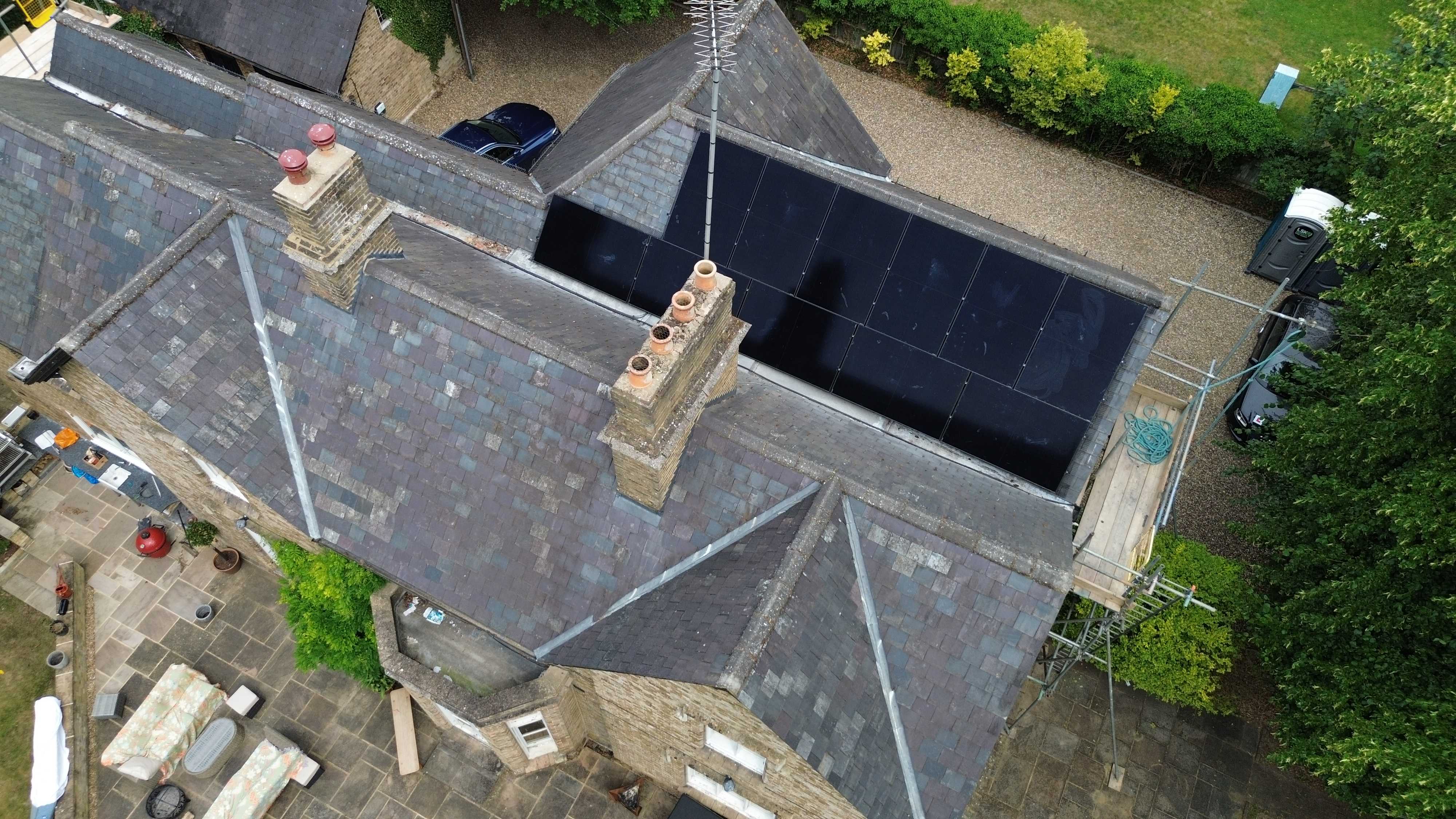
Muswell Hill (N10) — Victorian terrace, rear-facing slope. A 16-panel Aiko array sized to a period roof, with discreet all-black modules chosen to satisfy the conservation-area look. The owner reports saving over £100 a month. Tottenham (N17) — a regeneration-area Victorian terrace fitted with a mid-size array plus battery to capture generation while the household is out during the day. Enfield (EN2) — a suburban semi with a larger 6kW system and SigEnergy battery, taking self-consumption from roughly 35% to the high 70s. Barnet/Finchley (N12) — a 1930s semi with a south-facing rear elevation, a clean 4–5kW install with minimal scaffolding complexity.
What ties these together: rear-slope installs that keep panels off the street elevation (important in conservation areas), correctly sized batteries rather than oversold capacity, and scaffolding planned around tight terraced access. These are the details that separate a London-experienced installer from one that mostly works in open suburbs.
| Area | Property | System | Outcome |
|---|---|---|---|
| Muswell Hill (N10) | Victorian terrace | 16-panel Aiko, rear slope | Saving £100+/month; conservation-friendly |
| Tottenham (N17) | Victorian terrace | Mid-size array + battery | Captures daytime generation |
| Enfield (EN2) | Suburban semi | 6kW + SigEnergy battery | Self-consumption ~35% → ~78% |
| Finchley (N12) | 1930s semi | 4–5kW south-rear | Clean install, simple access |
London-specific install factors: conservation areas, scaffolding and planning
Most London solar installs go ahead under permitted development rights — you usually don't need planning permission as long as panels don't project significantly from the roof and aren't fitted on a wall facing (and visible from) a highway. The exceptions matter in London, though, because so much of the capital is covered by conservation areas and Article 4 directions.
Conservation areas (common across Camden, Haringey and parts of Barnet) don't automatically ban solar, but if your property is under an Article 4 direction, permitted development can be withdrawn and you'll need a planning application — particularly for any street-facing array. Our standard approach is to design onto rear or side slopes that aren't visible from the principal elevation, which keeps most jobs inside permitted development. Where an application is genuinely needed, we prepare and submit it for you. Our guide to solar panels in conservation areas walks through the detail.
The practical London headaches are physical, not just regulatory. Terraced and party-wall properties often need scaffolding erected from a rear garden with restricted access; a parking suspension may be required for the works vehicle; and flat-roof and mansard properties need ballasted or framed mounting rather than standard roof hooks. We survey for all of this before quoting — the figure we give you includes scaffolding and access, so the price you sign off is the price you pay.
| London factor | What it means for your install |
|---|---|
| Permitted development | Most rear-slope installs qualify — no application needed |
| Conservation area | Allowed, but design onto non-street-facing slopes |
| Article 4 direction | Planning application likely — we handle it |
| Terraced scaffolding | Often rear-garden access; £800–£1,500 in London |
| Parking suspension | ~£50–£100/day where needed — quoted inline |
| Flat roof / mansard | Ballasted or framed mounting, surveyed first |
Costs by system size, incentives and the Smart Export Guarantee
Below is a realistic London cost ladder. These are fully-fitted figures including scaffolding, installation and MCS certification — not panels-only headline prices. Your exact number depends on roof complexity, battery choice and access, which is why we survey before quoting. Try our ROI calculator to model your own payback, and our SEG calculator to estimate export income.
Incentives, dated honestly for 2026: solar panels and home battery storage currently qualify for 0% VAT in the UK — but this is the energy-saving materials (ESM) relief, which is scheduled to run until 31 March 2027 and then revert to 5% unless extended. Battery storage has been included at 0% since 1 February 2024 (including standalone batteries and retrofits). Always confirm the current position with your installer at the time of quoting, as government policy changes.
The Smart Export Guarantee (SEG) pays you for surplus electricity you export to the grid. SEG tariffs are set by individual suppliers and change frequently — at the time of writing the best flexible/fixed tariffs sit in the mid-teens of pence per kWh, but rates move month to month, so check live rates rather than relying on a figure quoted in any guide. For most London homes, the bigger win is self-consumption (using your own generation), which a correctly sized battery maximises.
| System size | Typical London cost (fitted) | Best-suited property | Indicative annual saving |
|---|---|---|---|
| 3kW (8 panels) | £6,000–£8,000 | Mid-terrace, 1–2 bed | £600–£850 |
| 4kW (10–11 panels) | £7,000–£9,500 | 3-bed terrace/semi | £800–£1,100 |
| 5kW (12–13 panels) | £8,500–£11,500 | Larger semi/detached | £1,000–£1,300 |
| 6kW+ (16+ panels) | £10,500–£16,500 | Detached / high usage | £1,200–£1,500 |
| Battery add-on | +£4,000–£7,000 | Daytime-empty homes | Boosts self-use to 70–90% |
Frequently Asked Questions
Who are the best solar panel installers in London?
Look for MCS certification (non-negotiable — it's required for the 0% VAT rate and Smart Export Guarantee), plus RECC and TrustMark membership for consumer protection. Beyond the badges, the differentiators in London are real local install experience (terraced-street scaffolding, conservation-area design), an in-house team rather than subcontracted labour, and aftercare you can actually phone. Sola UK is MCS, RECC and TrustMark certified with 700+ installs across North London and Hertfordshire. We're happy to put you in touch with a recent customer near you before you decide — and our best-solar-companies-in-London guide explains exactly what to compare.
How much do solar panels cost in London?
A typical 4kW system for a London home costs around £7,000–£9,500 fully fitted, and a larger 5–6kW system runs £8,500–£16,500 depending on roof and battery. London prices sit roughly 10–20% above the UK average, mostly because of scaffolding and access (£800–£1,500 vs £400–£800 nationally) plus parking suspensions on terraced streets. Our quotes include scaffolding and certification — no hidden extras. Use our ROI calculator for a personalised estimate.
Do I need planning permission for solar panels in London?
Usually not. Most London installs go ahead under permitted development rights, provided panels don't project significantly from the roof and aren't on a wall visible from a highway. The London exceptions are conservation areas and Article 4 directions (common in Camden, Haringey and parts of Barnet) — if your property has an Article 4 direction, you'll likely need a planning application, especially for any street-facing array. We design onto non-street-facing slopes to keep most jobs inside permitted development, and we prepare the application for you when one is genuinely needed.
Are solar panels worth it in London?
Yes — and counter-intuitively, London payback (5–7 years) often beats sunnier regions. London irradiance is slightly below the southern-England best (around 1,000–1,050 kWh per kW per year), but London electricity tariffs are among the highest in the UK (roughly 27–32p per kWh in 2026), so every self-consumed unit saves more. Over a 25-year panel lifespan, a typical London system delivers strong lifetime savings, and adding a battery pushes self-consumption from ~30–50% to 70–90%.
Which London areas and boroughs do you cover?
Our core coverage is North London — Barnet, Enfield, Haringey, Camden, Islington, Hackney, Waltham Forest and Tottenham (N1–N22, EN1–EN5) — where our St Albans base gives the fastest survey and aftercare response. We also serve East, West and northern South London on a job-by-job basis, plus the Hertfordshire–London fringe. See our North London hub for borough-level detail.
Do solar panels work on Victorian and period terraces?
Yes — Victorian and Edwardian terraces, which dominate much of North and East London, are well suited to solar. Most have a rear-facing roof slope that's ideal both for output and for conservation-area discretion. A standard mid-terrace typically takes 8–12 panels on the rear slope (around 3–5kW). We fit Aiko 485W all-black panels that sit low and look discreet on period roofs, and we plan scaffolding around tight terraced access.
What's the 0% VAT on solar, and how long does it last?
Solar panels and home battery storage currently qualify for 0% VAT under the UK's energy-saving materials relief — a meaningful saving versus 20% standard VAT. As of 2026, this relief is scheduled to run until 31 March 2027, after which it's set to revert to 5% unless extended; battery storage has been included at 0% since 1 February 2024. Because tax policy changes, always confirm the current rate with us at the point of quoting rather than relying on a figure in any guide.
How much can I earn from the Smart Export Guarantee in London?
The Smart Export Guarantee (SEG) pays you for surplus electricity exported to the grid. Rates are set by individual suppliers and change frequently — they move month to month, so we'd point you to live tariffs rather than a fixed number here. Our SEG calculator estimates your likely export income. For most London homes the larger benefit is self-consumption, which a correctly sized battery maximises, so we design around using your own generation first and exporting the rest.
Get your free, no-obligation quote
MCS-certified local installers — 700+ installs across Hertfordshire & North London.