
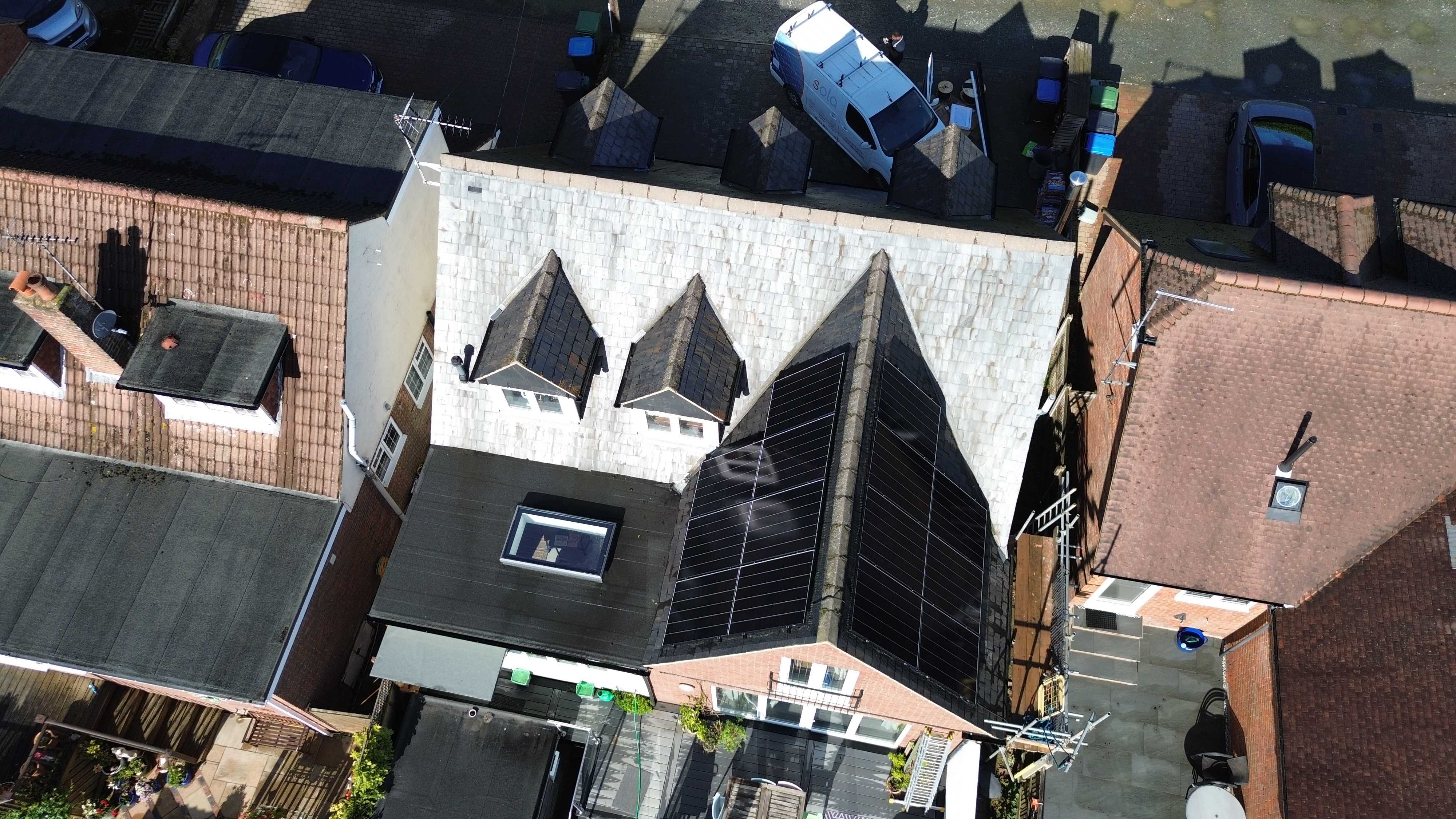
Residential Solar Installation in Hertfordshire
A residential solar installation is three jobs at once: a roofing job, an electrical job and a piece of grid paperwork. The quote you are comparing should show all three. SOLA UK is an MCS-certified installer based at Arquen House, 4-6 Spicer Street in St Albans, and we fit solar PV, battery storage and EV chargers for homes across Hertfordshire and North London.
This page sets out what the work actually involves, what the Energy Saving Trust says a typical system costs, how much a Hertfordshire roof generates at each orientation, and which permissions and notifications apply before and after the install.
Every figure below is attributed to the source it came from: the Energy Saving Trust for costs and lifespans, Ofgem for the electricity unit rate, the European Commission's PVGIS model for generation, legislation.gov.uk for permitted development, and MCS for the scheme rules. Where we could not evidence a number from a primary source, we have left it out rather than round it up. That includes panel efficiency and warranty lengths, which we will show you on the manufacturer's own paperwork instead of printing a headline figure on a web page.
Key Benefits of Residential Solar Installation
All-Black AIKO Modules
AIKO 485W all-black panels on an all-back-contact cell layout. Manufacturer datasheet supplied with your quote.
MCS Certified
MCS certification is the eligibility test for Smart Export Guarantee payments on your exported units.
0% VAT Until 31 March 2027
HMRC Notice 708/6 zero-rates domestic solar and battery installation to 31 March 2027, then 5%.
Based in St Albans
Arquen House, 4-6 Spicer Street, AL3 4PQ, covering Hertfordshire and North London.
Our Residential Solar Installation Process
Survey
Roof condition, pitch, orientation, shading and consumer unit capacity assessed on site.
Design
System designed and generation estimated to MCS MIS 3002, with the grid route decided.
Notify
G98 notification or, above 16 A per phase, a G99 application before work begins.
Install & Certify
Scaffold, mounting, modules and inverter fitted, then commissioning and your MCS certificate.
Residential Solar Technical Specifications
Panels
- AIKO 485W all-black modules
- All-back-contact cell layout
- Manufacturer datasheet issued with your quote
- Panel life 25 years or more (Energy Saving Trust)
Battery & Inverter
- Tesla Powerwall 3: 13.5 kWh energy capacity
- On-grid power up to 11.04 kW, depending on local conditions (Tesla UK)
- Integrated solar inverter and system controller
- SigEnergy battery systems also fitted
Standards & Paperwork
- MCS MIS 3002 V6.0, mandatory from 18 June 2026 (solar PV)
- MCS MIS 3012 (battery storage)
- G98 notification within 28 days of commissioning, or G99 before install
- MCS certificate issued for Smart Export Guarantee registration
What a residential solar installation actually involves, start to finish
The survey comes first, and it is as much a structural assessment as an electrical one. We look at the roof covering and its condition, the pitch and orientation of each usable slope, the usable area once you allow for vents, chimneys and edge set-backs, and shading across the day and across the year from trees, dormers and neighbouring buildings. Inside, the relevant questions are where the consumer unit sits, what spare capacity it has, whether the main supply is single or three phase, and how cable will run from roof to inverter without crossing the house.
Design follows the survey. MCS updated its solar PV installation standard, MIS 3002, to version 6.0 on 18 March 2026, with compliance mandatory from 18 June 2026, so the design and the generation estimate your contractor gives you should be produced to that version. At this stage the grid notification route is also decided, because that determines whether anything has to be approved before work can start.
The installation itself is scaffold, mounting system, modules, inverter or battery inverter, DC and AC isolation, labelling and the connection into the consumer unit. We do not publish an installation duration, because it depends on the roof, the scaffold and the weather, and a number on a web page would be a guess rather than a commitment.
Commissioning is where the job becomes a documented asset rather than equipment on a roof. You should finish holding a set of paperwork, because a future buyer's solicitor, your insurer and your export supplier will each want part of it.
- An MCS certificate for the installation, which is what an export supplier asks for
- The electrical installation certificate for the new circuits
- Confirmation that your distribution network operator has been notified or has approved the connection
- The module, inverter and mounting system datasheets, by make and model
- The generation estimate with the orientation, pitch and shading assumptions it was based on
- Written warranty terms stating who honours each one
What a residential solar installation costs, and the 0% VAT position
The Energy Saving Trust's benchmark, on a page last updated on 1 October 2026, is that “domestic solar panel systems are around 4.5 kWp and cost around £7,600”. That is a national average for a typical house, not a price for your roof, and we will not put a price on this page that pretends otherwise. What we can do is be clear about what moves the number.
The Energy Saving Trust lists the cost drivers as the size of the system, any difficulty accessing your roof, whether you choose panels or tiles, whether the panels are integrated into the building, and whether the roof covering needs renewing. It also notes that costs come down if scaffolding is already up for roof repairs, or if the house is a new build.
On VAT, HMRC's Notice 708/6 is explicit: “a zero rate applies to the installation of certain specified energy-saving materials from 1 May 2023 to 31 March 2027”, and “from 1 April 2027 onwards these will revert to the reduced rate of VAT of 5%”. Electrical storage batteries in residential accommodation were brought into the same temporary zero rate from 1 February 2024. So a domestic installation completed on or before 31 March 2027 carries no VAT, and the same work carries 5% afterwards. That is a deadline, not an offer, and we are not attaching any discount or finance scheme to it.
For payback, the Energy Saving Trust publishes periods by location. For London it gives nine years whether the household is home all day, home half the day or out all day, on figures it states are “based on fuel prices as of July 2026”. Hertfordshire sits just north of that modelling point, so nine years is the closest published reference rather than a promise about your house.
- System size in kWp
- Difficulty of access to the roof
- Panels or solar tiles
- Whether the array is integrated into the roof structure
- Whether the roof covering needs renewing first
What a Hertfordshire roof actually generates, by orientation
This is the question most solar pages avoid, because the honest answer is location-specific and needs stated assumptions. We ran the European Commission's PVGIS model for St Albans at 51.7527 north, 0.3394 west, for a 4.5 kWp array, at a 35 degree pitch, with 14% system losses, using the PVGIS-SARAH3 radiation database covering 2005 to 2023. Those are the assumptions, and changing any of them changes the answer.
A south-facing slope returns about 4,610 kWh a year. East returns about 3,700 kWh and west about 3,600 kWh, which is roughly 80% and 78% of the south figure. That is a much smaller penalty than most homeowners expect, and it is why an east or west roof is usually still worth doing.
The seasonal pattern matters more than the annual total if you are sizing a battery. On the south-facing case the model gives about 181 kWh in January against about 559 kWh in June, a ratio of roughly three to one. On east and west the January figure drops to about 83 kWh against about 535 and 522 kWh in June, a ratio closer to six to one. An east or west array loses most of its ground in winter, not in summer, which affects how much of the year a battery can usefully cycle.
A real roof differs from the model. Shading from a single chimney or a mature tree can take out more generation than a change of orientation, and PVGIS cannot see your chimney. Treat these numbers as the ceiling for a clean, unshaded slope in this part of Hertfordshire and expect a site-specific estimate to come in below them.
- South, 35 degree pitch: about 4,610 kWh a year
- East, 35 degree pitch: about 3,700 kWh a year
- West, 35 degree pitch: about 3,600 kWh a year
- Assumptions: 4.5 kWp, 14% system losses, St Albans, PVGIS-SARAH3 2005-2023
Planning permission and permitted development for roof solar
Most domestic roof solar in England is permitted development under Class A of Part 14 of Schedule 2 to the General Permitted Development Order, as amended by the Town and Country Planning (General Permitted Development) (England) (Amendment) Order 2026, which came into force on 27 August 2026. Permitted development is not the same as unregulated: there are dimensional limits and they are enforceable.
On a pitched roof the equipment must not protrude “more than 0.2 metres beyond the plane of the wall or, in the case of a pitched roof, the roof slope when measured from the perpendicular”, and it must not sit higher than the highest part of the roof, excluding any chimney. A standard framed array on hooks and rails stays inside that limit; an elevated frame on a pitched roof generally does not.
Conservation areas are widely misunderstood. The Class A restriction in a conservation area bites on equipment that would be installed on a wall, balcony or roof enclosure fronting a highway. It is not a blanket ban on roof slopes. A rear or side roof slope in a conservation area is frequently still permitted development, which is worth knowing before anyone tells you your house is ineligible.
Two situations do change the answer. A flat-roof array on article 2(3) land, which includes conservation areas, requires you to “apply to the local planning authority for a determination as to whether the prior approval of the local planning authority will be required”. And a listed house sits outside Class A altogether, so listed building consent is the route. Class A also carries a standing condition that equipment is “sited so as to minimise its effect on the external appearance of the building”.
- Pitched roof: no more than 0.2 m beyond the plane of the roof slope, and not above the highest part of the roof excluding the chimney
- Conservation area: the restriction is on a wall, balcony or roof enclosure fronting a highway, not on roof slopes
- Flat roof on article 2(3) land: apply for a prior approval determination
- Listed house: outside Class A, so listed building consent applies
The grid paperwork: G98, G99, and why a battery changes it
Every grid-connected installation has to be registered with your distribution network operator, and which form is used, and when, depends on size. MCS sets the threshold at “up to and including 16A per phase”, which is 3.68 kW on a single-phase supply or 11.04 kW across three phases.
Below that threshold the route is EREC G98, and the notification happens after the work. MCS guidance is to “notify the relevant DNO within 28 days of the system being commissioned”. Above it, EREC G99 applies, prior permission to connect has to be granted, and that application goes in before installation rather than after. The practical consequence is a lead time you need to know about at quotation stage, not after you have paid a deposit.
Batteries are where this catches people out. MCS states that “if you are installing battery storage in conjunction with another technology (e.g., solar PV), the total connected generation is likely to be above 16 amps per phase, so EREC G99 will apply”. In other words, a solar array that would have been a simple post-commissioning notification becomes a pre-approval job once a battery is added. If you are considering a battery now or later, say so at survey stage so the application is made once rather than twice.
Which network operator you deal with is set by your meter point administration number, not by your postcode. Ask whichever contractor you use to confirm the operator from your MPAN and to tell you in writing who submits the form and who tracks it.
- 16 A per phase is the dividing line: 3.68 kW single phase, 11.04 kW across three phases
- G98: notify the network operator within 28 days of commissioning
- G99: prior permission to connect, applied for before installation
- Adding a battery to solar is likely to push the installation into G99
Where the money comes from: self-consumption versus the Smart Export Guarantee
Two published numbers set the economics. Ofgem's price cap for 1 October to 31 December 2026 puts electricity at “26.32 pence per kWh” with a “54.83 pence daily standing charge” for a typical direct debit customer in Great Britain. Octopus Energy's variable Outgoing Octopus tariff pays “12p per kWh for every unit you export”.
Put those side by side and the whole design logic of a domestic system falls out: a unit you use in the house is worth about 2.2 times a unit you send to the grid. Solar does not touch the standing charge at all. That is why the useful question is not how much a system generates, but how much of what it generates you are at home to use.
Here is the arithmetic on the south-facing St Albans case above, at three self-consumption levels. These are worked examples on stated assumptions. They are not a quotation, not a forecast, and not a claim about what your house will do.
At 50% self-consumption that lands near the Energy Saving Trust's published nine-year payback for London against its roughly £7,600 benchmark, which is a reasonable sign the arithmetic is not drifting. To collect export payments at all you need the Smart Export Guarantee, which Ofgem describes as open to installations “up to a capacity of 5MW” in Great Britain, with payments “calculated by using export meter readings”. MCS sets the eligibility test for the installation itself: “your system was installed by an MCS certified installer using certified products”. Suppliers set their own rates, so shop the export tariff separately from the installation.
- 40% used in the house: about £820 a year (about £486 avoided import, about £332 export)
- 50% used in the house: about £880 a year (about £607 avoided import, about £277 export)
- 60% used in the house: about £950 a year (about £728 avoided import, about £221 export)
- Based on 4,610 kWh a year, 26.32p import and 12p export; the standing charge is unaffected
The equipment we fit, and the specifications we will not quote
On panels we fit AIKO 485W all-black modules, built on an all-back-contact cell layout that puts the electrical contacts on the rear of the cell. We are not printing a module efficiency percentage on this page. We could not retrieve that figure from AIKO's own datasheet while preparing it, several resellers publish slightly different numbers for different variants of the same 485W module, and a performance figure sourced from a reseller is not a specification. You will get the manufacturer's datasheet with your quote, and the number on that document is the one that counts.
For batteries and hybrid inverters we fit SigEnergy systems and the Tesla Powerwall 3. Tesla's United Kingdom specification for Powerwall 3 gives an energy capacity of 13.5 kWh and on-grid power of “up to 11.04 kW, depending on local conditions”, with an integrated solar inverter and system controller and a stated solar-to-grid efficiency of 97.5%. Note that 11.04 kW is the United Kingdom figure; the 11.5 kW number that circulates online is from Tesla's United States documentation, and we have used the one that applies here.
On lifespan, the Energy Saving Trust's position is that “your solar panels should last 25 years or more” but “if you have a solar inverter, you need to replace this after around 12 years”. That is a market expectation from an independent body, not a warranty from us. We will give you the warranty terms for every component in writing, naming who honours each one, and we are deliberately not advertising a warranty length here because the honest version of that claim belongs in your contract rather than in a heading.
Maintenance is light. The Energy Saving Trust notes that “in the UK, rain will clean your panels if they're tilted at 15 degrees or more”, which covers a normal pitched roof. The jobs that genuinely need attention are keeping nearby trees trimmed and acting on inverter fault signals.
Adding battery storage to a residential solar installation
A battery changes a solar system from a daytime generator into something closer to a load-shifting asset, and at a 2.2 to 1 ratio between the import rate and the export rate there is a clear case for storing a unit rather than selling it. But the case is not automatic, and the Energy Saving Trust says so plainly: savings “won't always be enough on their own to justify the cost of the battery”.
On cost, the Energy Saving Trust puts battery storage at anywhere from £1,500 to £10,000 depending on type and size, with “the cost for a 5kWh battery system around £4,600”, on a page last updated on 6 October 2026. It describes a typical home system as around 10 kWh and a typical unit as roughly 100cm by 60cm by 25cm, which is a little taller and wider than a washing machine but much shallower. It also puts typical battery life at about 10 to 12 years, shorter than the panels, so plan on replacing it once within the life of the array.
Two practical points. Fitting the battery at the same time as the panels avoids paying twice for access and commissioning, and the Energy Saving Trust makes the same observation. And as above, adding a battery is likely to move the installation from a G98 notification to a G99 pre-approval, so it belongs in the conversation before the grid paperwork is submitted rather than after. MCS covers battery installations under a separate standard, MIS 3012.
Both batteries and solar panels sit inside the temporary VAT zero rate that runs to 31 March 2027, batteries having been added to it on 1 February 2024.
How to compare residential solar installers
The Energy Saving Trust's advice is to “get quotes from at least three installers” and to “make sure the installers you look at are MCS-certified”. MCS certification is not a badge of taste, it is the eligibility test for export payments: your system must have been “installed by an MCS certified installer using certified products” to qualify for the Smart Export Guarantee. An uncertified installation is not just lower assurance, it is locked out of the export market.
Check the certification yourself on the MCS register rather than taking a logo on a website as evidence. One thing worth knowing when you do: certification is held by a legal entity, and a company's trading name is not always the name on the register. Ask any contractor which registered company holds the certification and for which technology, then look up that name. Certification is also per technology, so a firm certified for solar PV is not automatically certified for batteries or heat pumps.
MCS certification requires membership of a consumer code recognised by the Chartered Trading Standards Institute. SOLA UK is a member of the Renewable Energy Consumer Code and is also TrustMark registered and an OZEV approved installer. Ask what the code actually gives you, because deposit protection and dispute resolution are the parts that matter if something goes wrong.
Then compare the documents rather than the headline prices. The version question is worth asking directly: MIS 3002 moved to version 6.0 on 18 March 2026 and became mandatory on 18 June 2026, so ask whether the generation estimate in front of you was produced to the current version of the standard. A quote with no kWh estimate, no module make and model, and no named legal entity is not a cheaper quote, it is an incomplete one.
- Three quotes minimum, all from MCS-certified contractors
- Verify the certification on the MCS register, under the registered legal entity name, for the technology you are buying
- Confirm the consumer code, and what deposit protection and dispute resolution it provides
- Compare system size in kWp, module make and model, and the kWh estimate with its assumptions
- Establish in writing who submits the G98 or G99, who issues the MCS certificate, and who honours each warranty
Residential Solar Installation: Frequently Asked Questions
How much does it cost to get solar panels put on a house?
The Energy Saving Trust's benchmark, on a page last updated on 1 October 2026, is that domestic systems are around 4.5 kWp and cost around £7,600. That is a national average rather than a price for your roof. The Trust lists the main variables as system size, difficulty of roof access, panels versus tiles, whether the array is integrated into the roof, and whether the roof covering needs renewing first. Domestic installations currently carry 0% VAT until 31 March 2027, reverting to 5% from 1 April 2027. We quote per roof after a survey rather than publishing a price.
Is there a 20% rule for solar panels in the UK?
No. There is no 20% rule in United Kingdom planning or grid regulation, despite the question appearing frequently in search results. The limits that genuinely apply are dimensional and electrical. Under Class A of Part 14 of Schedule 2 to the General Permitted Development Order, roof equipment must not protrude more than 0.2 metres beyond the plane of the roof slope and must not sit above the highest part of the roof, excluding the chimney. On the electrical side, MCS puts the threshold between a G98 notification and a G99 application at 16 A per phase, which is 3.68 kW single phase. Those are the real numbers.
Do I need planning permission for solar panels on my roof?
Usually not. Most domestic roof solar in England is permitted development under Class A of Part 14 of Schedule 2 to the General Permitted Development Order, as amended with effect from 27 August 2026, provided the equipment stays within 0.2 metres of the plane of the roof slope and below the highest part of the roof. In a conservation area the restriction applies to a wall, balcony or roof enclosure fronting a highway rather than to roof slopes generally. A flat-roof array on article 2(3) land needs a prior approval determination, and a listed house falls outside Class A entirely.
Why does my installer have to be MCS certified?
Because the Smart Export Guarantee depends on it. MCS states the eligibility test directly: your system must have been installed by an MCS certified installer using certified products. Ofgem's scheme covers installations up to 5MW in Great Britain and pays on export meter readings, but without an MCS certificate a supplier cannot put you on its regulated export tariff. Certification is held by a named legal entity and granted per technology, so check the register for the registered company name and for the specific technology you are buying, not just for the trading name.
Will my installation need network operator approval before it starts?
It depends on size, and a battery often decides it. MCS puts the dividing line at 16 A per phase, which is 3.68 kW on a single-phase supply or 11.04 kW across three phases. Below that, EREC G98 applies and the network operator is notified within 28 days of commissioning, so nothing holds the job up. Above it, EREC G99 applies and prior permission to connect must be granted before installation. MCS notes that adding battery storage alongside solar is likely to take the total above 16 A per phase, so mention any battery plans at survey stage.
How much will a system actually save at the current price cap?
It depends almost entirely on how much you use at home rather than export. Ofgem's cap for 1 October to 31 December 2026 prices electricity at 26.32p per kWh, while Octopus Energy's variable Outgoing Octopus tariff pays 12p per kWh exported, so a unit you use yourself is worth about 2.2 times a unit you sell. On the PVGIS figure of about 4,610 kWh a year for a south-facing 4.5 kWp array in St Albans, that works out at roughly £820 a year at 40% self-consumption and roughly £950 at 60%. Solar does not reduce the standing charge.
Does a south-facing roof really matter that much?
Less than most people assume on an annual basis, more than they assume in winter. Our PVGIS run for St Albans, at 4.5 kWp, 35 degree pitch and 14% system losses, gives about 4,610 kWh a year facing south, about 3,700 kWh facing east and about 3,600 kWh facing west, so east or west returns roughly 78 to 80% of south. The seasonal profile differs more sharply: south runs about three to one between June and January, while east and west run closer to six to one. Shading from a chimney or tree can cost more than orientation does.
Do solar panels make a house harder to sell?
An owned, properly documented system should not, and the documentation is the point. A buyer's solicitor will typically want the MCS certificate, the electrical installation certificate, evidence that the distribution network operator was notified or approved the connection, and the warranty terms. The transactions that historically caused friction were ones where the roof itself was leased to a third party under an old feed-in tariff arrangement, because the buyer inherited a lease rather than an asset. Keep the handover pack from your installation somewhere you can find it.
Should I add a battery at the same time as the panels?
Often, but not automatically. The Energy Saving Trust is direct that battery savings will not always be enough on their own to justify the cost, and puts battery storage between £1,500 and £10,000 with a 5 kWh system around £4,600, describing a typical home system as around 10 kWh with a life of about 10 to 12 years. The arguments for doing it together are that you pay once for access and commissioning, that both are zero-rated for VAT until 31 March 2027, and that the G99 application is made once rather than twice.
Residential Solar Installation Across Hertfordshire & North London
From our St Albans base we cover a ~30-mile radius. Explore residential solar in your area: