
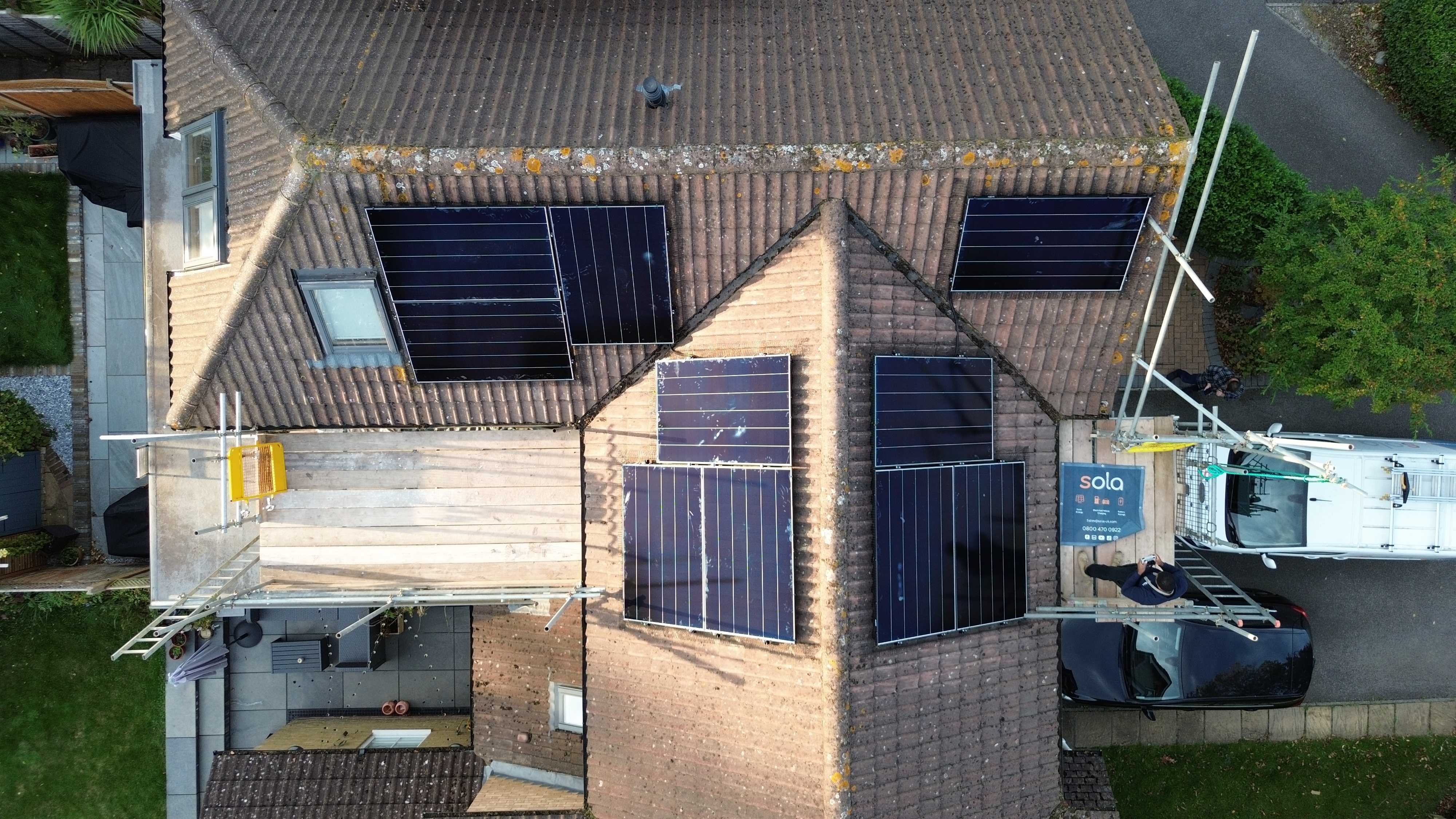
MCS Certified Solar Panel Installers in Hertfordshire & North London
What MCS certified solar installers are (quick answer)
MCS certified solar installers are businesses certified under the Microgeneration Certification Scheme (MCS) to install solar PV to MCS standards. For a solar PV system up to 50kW, Ofgem's Smart Export Guarantee guidance says you will be asked to show that both the installation and the installer are suitably certified, and an MCS certificate is one way to do that.
Choosing one comes down to checks, not logos. Find the business on the MCS register for the technology you are buying, match the certification number on your quote, confirm any consumer code or TrustMark claim on those schemes' own registers, and check how your deposit is protected before you sign. For the paperwork you receive after installation, see what an MCS certificate is.
SOLA UK is an MCS certified installer based in St Albans, with 700+ installations completed company-wide. We install solar PV, battery storage and EV chargers for domestic and commercial customers. The official source for every check on this page is linked, so you can run the same checks on us.
How to check an installer is genuinely MCS certified
Certification on its own is common: MCS reported more than 5,250 certified contractors in March 2025. What you need to confirm is that the specific business quoting you is certified for the technology you are buying, and that your paperwork shows the protections involved. You can check each step below on an official register or against published MCS guidance before you sign.
1. Search the MCS Find an Installer register
Go to MCS Find an Installer and search by installer name or certification number, or by technology and your location. Confirm the business is listed for solar PV, and for battery storage too if a battery is on the quote. MCS suggests checking as you get a quote, before you sign the contract and before installation starts, so you know the installer has stayed certified throughout.
2. Match the name and number on your quote
MCS's Guidance for Contracts and Quotations says a quotation should include the business name, company registration number and MCS certification number. Enter that number on the MCS register and check it returns the same business. MCS also says your installer should tell you about any subcontractors involved in the installation, so you know who will be at your property.
3. Check any consumer code membership on its own register
If an installer says it belongs to RECC or HIES, search the RECC member directory by company name, postcode, region or technology, or use the Find an Installer tool on the HIES website. Both codes are approved by the Chartered Trading Standards Institute. Consumer code membership is no longer mandatory on MCS's redeveloped installer scheme, so check what an installer actually claims rather than assuming every installer belongs to one.
4. Confirm TrustMark registration for the right trade
TrustMark describes itself as the Government Endorsed Quality Scheme that covers work a consumer chooses to have carried out in or around their home. Use the Find a Tradesperson search on trustmark.org.uk and, as TrustMark advises, check the business is registered for the specific trade you need. Ofgem's SEG guidance for generators does not mention TrustMark, so treat it as a separate check from MCS certification.
5. Check the protection named in your paperwork
MCS guidance says a quotation should give details of any guarantees or warranties and how long they are valid for, any financial protection products included, and how any deposit will be protected. MCS says every installer will need to buy an MCS approved financial protection product on behalf of their customer, and approved products are listed on the MCS website. RECC's consumer guidance says you should not be required to pay more than 25% of the final contract price as a deposit.
If an installer cannot give you a certification number that matches the register, or pushes you to sign on the day, pause. MCS's contracts guidance tells installers to give customers plenty of time to review and not to pressure them to sign. Its scam advice warns that some installers pose as MCS certified when they are not. Run these checks on SOLA UK too before you ask us for a quote.
MCS, RECC, HIES, TrustMark, NICEIC/NAPIT and Flexi-Orb: what each one covers
A row of logos does not tell you what each scheme does. The schemes answer different questions: whether the installation meets a technical standard, what protects your money if something goes wrong, and whether building work can be self-certified. On certification for export payments, Ofgem's SEG guidance refers only to MCS or schemes equivalent to it.
The table sets out what each scheme covers and what, if anything, Ofgem's Smart Export Guarantee guidance ties to it. Check any accreditation an installer claims on that scheme's own register.
| Scheme | What it covers | Smart Export Guarantee |
|---|---|---|
| MCS Microgeneration Certification Scheme | Certifies installers and products against MCS standards. The solar PV installation standard is MIS 3002, updated in March 2026, and battery installation has its own standard, MIS 3012. MCS runs the Find an Installer register, handles complaints about MCS certified installers, and says every installer will need to buy an MCS approved financial protection product on behalf of their customer. | Ofgem's generator guidance says an MCS certificate may be how you show that a solar PV installation up to 50kW, and its installer, are suitably certified. Without suitable certification a SEG licensee is not obliged to pay, although it can. |
| RECC Renewable Energy Consumer Code | A consumer code approved by the Chartered Trading Standards Institute that sets standards for selling or leasing small-scale heat and power generators. Members must insure deposits, stage payments and the workmanship warranties they issue against the installer ceasing to trade. RECC says consumers should not be required to pay more than 25% of the final contract price as a deposit. Members can be searched by company name, postcode, region and technology. | None directly: Ofgem's SEG guidance for generators does not mention consumer codes. MCS's redeveloped scheme no longer makes consumer code membership mandatory. |
| HIES Home Insulation and Energy Systems Contractors Scheme | A consumer protection organisation whose accredited installers operate under a CTSI approved consumer code. HIES lists alternative dispute resolution, deposit and stage payment protection, and insurance-backed guarantees, and has its own Find an Installer tool. | None directly: Ofgem's SEG guidance for generators does not mention consumer codes. For contracts entered into before 1 January 2025, MCS says dispute resolution can be accessed through the installer's consumer code (RECC or HIES). |
| TrustMark TrustMark, the Government Endorsed Quality Scheme | Covers work a consumer chooses to have carried out in or around their home. TrustMark says registered businesses have been thoroughly vetted to meet required standards, and advises checking that a business is registered for the specific trade you need. | None: Ofgem's SEG guidance for generators does not mention TrustMark. |
| NICEIC / NAPIT Competent person schemes (Certsure LLP t/a NICEIC; NAPIT) | GOV.UK says competent person schemes let installers self-certify certain types of building work instead of getting building regulations approval, and lists Certsure (trading as NICEIC) and NAPIT among the electrical schemes. MCS separately lists Certsure (NICEIC) and NAPIT among its installer certification bodies. | None in their own right: Ofgem's SEG guidance for generators does not mention competent person schemes. |
| Flexi-Orb Flexi-Orb (Flexible Energy Oversight Registration Body) | An installation certification scheme covering solar PV up to 50kW, electrical energy storage up to 50kWh and EV charge points up to 22kW. Its certified installers must be members of, and comply with, a CTSI approved consumer code. | Ofgem's guidance does not name Flexi-Orb. It says SEG recognises that other schemes may be equivalent to MCS, with installation and installer accredited to EN 45011 or EN ISO/IEC 17065:2012, and the GOV.UK SEG page names the Flexi-Orb renewables scheme as an example. Ofgem advises speaking to your chosen SEG licensee about what it needs. |
A long row of logos does not guarantee export payments. On certification, Ofgem's SEG guidance looks at the installation and installer, through MCS or a scheme equivalent to it. Financial protection products and consumer code rules affect what happens to your money if something goes wrong, and TrustMark and competent person schemes are separate checks again. Check each claim on its own register, for the technology you are buying. SOLA UK is MCS certified, a RECC member, TrustMark registered and an OZEV approved installer, and you can check all of these on the registers above.
What MCS certification covers on your installation
For solar PV, the technical rulebook is MIS 3002, the Solar PV Installation Standard. After a five-week consultation published in November 2025, MCS issued updated versions on 18 March 2026: MIS 3002 V6.0 for the current installer scheme, and MIS 3002:2025 V2.0 for the redeveloped scheme. The update addresses clause 5.5.5, which covers installations where no certified mounting systems are available under MCS 012. Compliance became mandatory for installers certified to MIS 3002 from 18 June 2026. Current versions are in the MCS Standards and Tools Library.
Consumer protection under MCS is changing. On the redeveloped installer scheme, which MCS says most installers will move onto during 2026, consumer code membership is no longer mandatory. Installers hold an Installer Agreement directly with MCS, follow the MCS Customer Commitment, and complaints are managed centrally by MCS. MCS also says every installer will need to buy an MCS approved financial protection product on behalf of their customer; the protection section below explains what that covers.
Products count too. MCS says certified installers use MCS certified products, including solar panels and mounting kits. SOLA UK's range includes AIKO 485W panels, SigEnergy battery systems and Tesla Powerwall 3 (13.5 kWh, 11.5 kW continuous). Whoever quotes you, MCS guidance says the quote should describe the products by make and model, so you can compare quotes like for like and check exactly what you are being offered before you sign.
Why MCS matters for your Smart Export Guarantee payments
Installer certification matters for export payments. Ofgem's SEG guidance for generators says that for solar PV up to 50kW you will be asked to show that both the installation and the installer are suitably certified. That may be an MCS certificate, and Ofgem says other schemes may be equivalent to MCS. If you cannot show suitable certification, a SEG licensee is not obliged to pay, although it can. That is why certification is worth confirming before you sign, not after installation.
GOV.UK says SEG suppliers must offer a tariff but are free to set its terms. Octopus lists Outgoing Octopus, a variable tariff, at 12p per kWh exported. Ofgem's price cap electricity rate for 1 October to 31 December 2026 is 26.32p per kWh. At those rates, a unit you use yourself on a capped tariff avoids more cost than a unit you export earns. Run your own figures in the SEG calculator or compare tariffs in our Smart Export Guarantee rates guide.
What protects you if a solar installer stops trading?
It depends on which MCS scheme your installer is on and what your paperwork names. MCS says every installer will need to buy an MCS approved financial protection product on behalf of their customer. MCS describes it as a financial safety net that supports the cost of remediation when you cannot get an issue resolved through your original installer. That includes cases where the installer goes bankrupt, has retired or refuses to put things right. MCS says the cover lasts at least six years from installation, with the excess capped at £250.
If your installer is a RECC member, RECC requires it to insure the deposits and stage payments it takes, and the workmanship warranties it issues, in case the business stops trading. RECC is clear that it is not an insurance company, and that you will not be covered unless your installer has registered your installation with an insurance company or other provider. Ask for the provider's name in writing.
For complaints, MCS asks you to raise the issue with your installer first, and says 14 days is a reasonable maximum time to expect a response. You then escalate to MCS, which acknowledges complaints within 5 working days and says most should be fully resolved within 8 weeks. For eligible disputes, alternative dispute resolution is free and funded by MCS, through the Dispute Resolution Ombudsman operating as The Furniture & Home Improvement Ombudsman. If your contract was entered into before 1 January 2025, ADR can still be accessed through the installer's consumer code (RECC or HIES).
- The name of any financial protection product or insurance provider, in writing
- How your deposit and any stage payments are protected, and by whom
- The installer's complaints procedure and how to escalate to MCS
- Which dispute resolution route applies to your contract
Red flags in a solar quote, measured against MCS and RECC guidance
MCS publishes guidance telling certified installers what a quotation and contract should contain, and RECC publishes consumer guidance on deposits and sales practices. If a quote falls short, ask about it before you sign. MCS also says to aim for at least three quotes, so you can be more confident about cost and timescale.
Pressure is a warning sign in itself. MCS's guidance tells installers to give customers plenty of time to review before signing and not to pressure them to sign. Its scam advice says cold callers and door-sellers often offer urgent deals, that you should not sign up for anything on the spot, and that MCS will never cold call you.
- No MCS certification number on the quote, or a number that brings up a different business on the register
- No make, model or specification for the products being quoted
- A deposit above 25% of the final contract price (RECC's guidance), or no explanation of how the deposit is protected
- No details of guarantees or warranties, how long they last, or which financial protection product is included
- A contract with no cancellation rights, no complaints procedure or no route to escalate to MCS
- A discount that only applies if you sign the same day, a sales practice RECC's consumer guidance warns about
- Subcontractors you were not told about
Adding a battery: check the installer is certified for storage too
MCS has a separate standard for installing battery storage: MIS 3012, the Battery Installation Standard. MCS says it covers installations up to 50kW and four classes of electrical energy storage system, based on how the components are packaged and whether they come from the same manufacturer. In class 4, components can all come from different manufacturers and are selected and assembled by the installer to be compatible. If a quote combines panels and a battery, check the MCS register lists the installer for both solar PV and battery storage.
SOLA UK's battery options include SigEnergy systems and Tesla Powerwall 3 (13.5 kWh, 11.5 kW continuous). See battery storage for the range.
SOLA UK: the evidence you can check
You should not have to take any installer's word for its credentials, including ours. SOLA UK Ltd is based at Arquen House, 4-6 Spicer Street, St Albans AL3 4PQ, and has completed 700+ installations company-wide. We install solar PV, battery storage and EV chargers for domestic and commercial customers.
SOLA UK is MCS certified, a RECC member, TrustMark registered and an OZEV approved installer. To check, search the MCS register and the RECC member directory, and look the business up on TrustMark's Find a Tradesperson. A company's registered name can differ from the name it trades under, so if a name search comes up empty, also try the RECC directory's postcode search with AL3 4PQ. Ask for the MCS certification number and compare it with the register.
For customer feedback, read SOLA UK's reviews on Google and Trustpilot directly, where you can see each one in full and judge it for yourself.
MCS certified solar installers near you in Hertfordshire
SOLA UK is based at Arquen House in St Albans and installs solar PV, battery storage and EV chargers for domestic and commercial customers. Start with the Hertfordshire solar hub or the St Albans page, and see residential solar installation for home systems.
Whoever makes your shortlist, run the same register checks on each business, aim for at least three quotes as MCS suggests, and compare them like for like. Our guide to solar companies in Hertfordshire can help you build that shortlist. To talk to SOLA UK, call 0800 470 0922.
Frequently Asked Questions
Are all solar installers MCS certified?
No. MCS says an MCS certificate is not a mandatory or legal requirement for installing a system, and warns that some installers pose as MCS certified when they are not. Search the business on MCS Find an Installer by name or certification number, and make sure the number on your quote matches. For solar PV up to 50kW, Ofgem says a SEG licensee is not obliged to pay for exported electricity if you cannot show the installation and installer are suitably certified, although it can.
Do I need an MCS certified installer for the Smart Export Guarantee?
For solar PV up to 50kW, Ofgem's generator guidance says you will be asked to show that the installation and installer are suitably certified. That may be an MCS certificate. Ofgem also says other schemes may be equivalent to MCS, with installation and installer accredited to EN 45011 or EN ISO/IEC 17065:2012, and GOV.UK names the Flexi-Orb renewables scheme as an example. If you cannot show suitable certification, a SEG licensee is not obliged to pay, although it can.
How do I check an installer's MCS certification number?
Ask for it first: MCS guidance says a quotation should include the installer's MCS certification number and company registration number. Enter the number in MCS Find an Installer, which searches by installer name or certification number, and check it returns the business that quoted you. MCS suggests checking as you get a quote, before you sign and before installation starts, so you know the installer has stayed certified throughout.
Does an MCS installer have to belong to RECC or HIES?
Not on MCS's redeveloped installer scheme, which lists consumer code membership as no longer mandatory. MCS says most installers will move onto that scheme during 2026. MCS also says every installer will need to buy an MCS approved financial protection product on behalf of their customer, and MCS manages complaints centrally. RECC and HIES are both approved by the Chartered Trading Standards Institute. If an installer claims membership of either, check it on that code's own register.
What is the difference between MCS, RECC and TrustMark?
MCS certifies installers and products against technical standards, such as MIS 3002 for solar PV, and Ofgem's SEG guidance names an MCS certificate as a way to show certification. RECC is a consumer code approved by the Chartered Trading Standards Institute that sets standards for selling small-scale heat and power generators, and requires members to insure deposits, stage payments and workmanship warranties against the installer ceasing to trade. TrustMark describes itself as the Government Endorsed Quality Scheme for work a consumer chooses to have carried out in or around their home. Check each claim on that scheme's own register.
Which version of MIS 3002 applies to new solar installations?
MCS issued updated versions of MIS 3002, the Solar PV Installation Standard, on 18 March 2026: V6.0 for the current installer scheme and MIS 3002:2025 V2.0 for the redeveloped scheme. Compliance became mandatory for MCS installers certified to MIS 3002 from 18 June 2026. The update addresses clause 5.5.5, which covers installations where no certified mounting systems are available under MCS 012. Its requirements include written confirmation from the installer that the installation follows the manufacturer's instructions. Battery installation has its own standard, MIS 3012.
What can I do if my installer stops trading or will not fix a problem?
Raise it with the installer first; MCS says 14 days is a reasonable maximum time to expect a response. Then escalate to MCS, your single point of contact for complaints about MCS certified installers. If an MCS approved financial protection product was bought for your installation, MCS says it supports the cost of remediation when you cannot get a resolution through your original installer, including if the installer goes bankrupt, has retired or refuses to carry out the work. RECC members must also insure deposits, stage payments and workmanship warranties against ceasing to trade. For eligible disputes, alternative dispute resolution is free and funded by MCS.
Is MCS certification the same as NICEIC or NAPIT registration?
No. Certsure (which trades as NICEIC) and NAPIT run competent person schemes. GOV.UK says these let installers self-certify certain types of building work, including electrical work, instead of getting building regulations approval. MCS certification covers installing renewable technologies to MCS standards. The link between them is that MCS also lists Certsure (NICEIC) and NAPIT among its installer certification bodies. Ofgem's SEG guidance for generators does not mention competent person schemes.
Is the 0% VAT on solar panels and batteries still available?
Yes. VAT on domestic solar panels and batteries is 0% until 31 March 2027, after which it rises to 5%. MCS guidance says a quotation should show the total price net of VAT, the amount of VAT and the total price including VAT, so you can see which rate a quote has applied.
Get your free, no-obligation quote
MCS-certified local installers — 700+ installs across Hertfordshire & North London.