How Much Electricity Will Solar Panels Make in Slough?
PVGIS estimates for a 4kWp solar array in Slough, south-facing versus east-west, month by month, plus what Census 2021 and export rates mean for you.
How Much Electricity Will Solar Panels Make in Slough?
Ask how much a solar array will generate and you will often hear a national rule of thumb. Slough has its own solar resource and its own mix of houses and flats, so it is worth running the numbers for the town itself.
We used PVGIS, the solar model run by the European Commission's Joint Research Centre, to estimate output for a home array in Slough. The headline result: a 4kWp array facing due south is estimated to make about 4,120kWh a year, while the same 4kWp split between east and west roof slopes makes about 3,252kWh.
If you are comparing solar panel installers in Slough, these are the figures to ask each one to rework for your own roof, because orientation alone moves the answer by around a fifth.
The assumptions behind these estimates
PVGIS works from long-term radiation data, so treat its figures as a typical year rather than a promise for any particular one. We used these settings:
- Location: latitude 51.5105, longitude -0.595, in Slough
- System size: 4kWp of crystalline silicon panels
- Tilt: 35 degrees
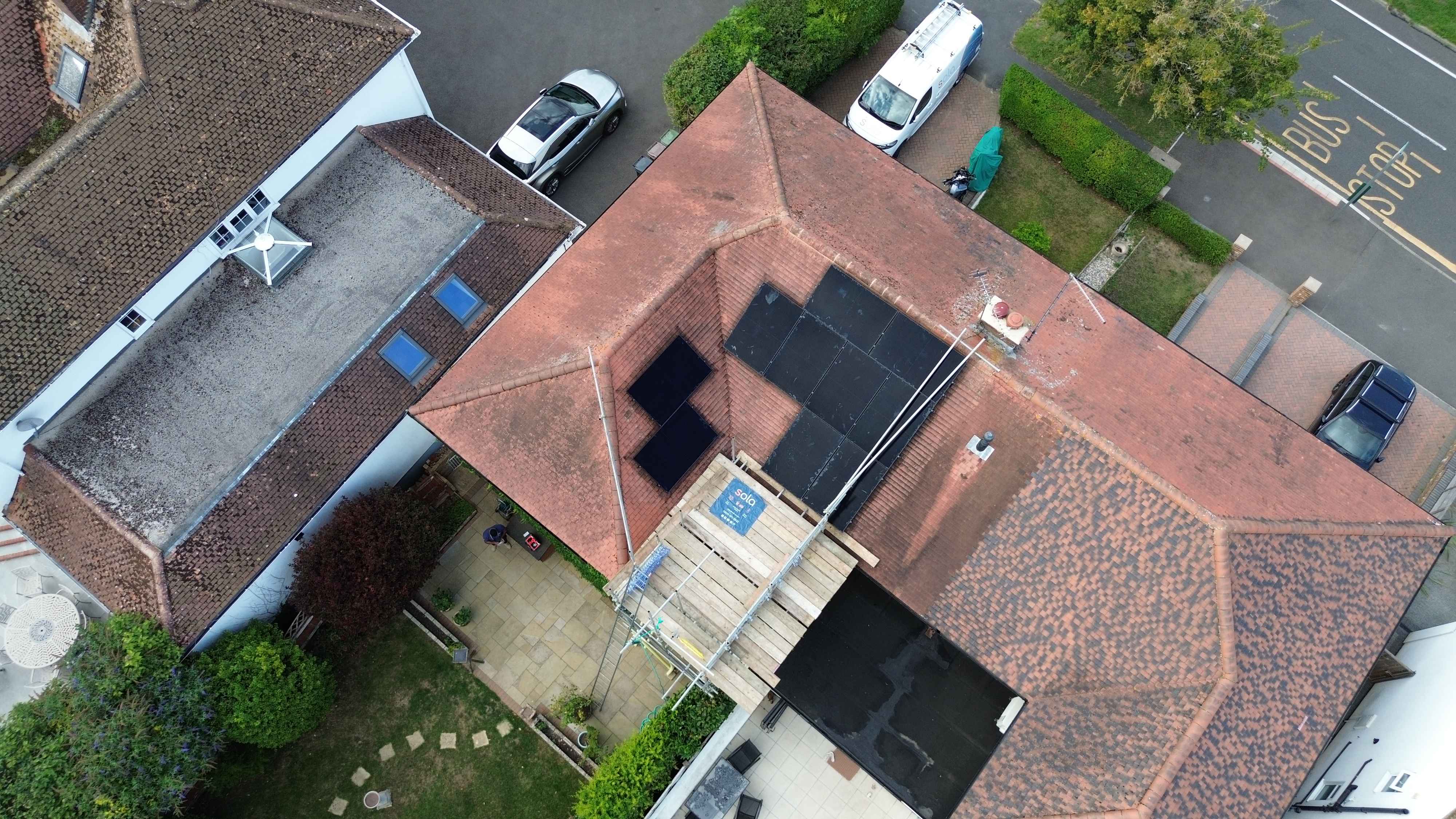
- Orientation: due south, or 2kWp facing east plus 2kWp facing west
- System losses: 14%
- Radiation data: PVGIS-SARAH3, covering 2005 to 2023, with terrain horizon shading included
- Mounting: the PVGIS free-standing option
The model's horizon is calculated from terrain only, so nearby trees, chimneys and neighbouring buildings are not included. That is one reason a roof survey still matters.
Month by month: south-facing versus east-west
| Month | South-facing 4kWp (kWh) | East-west 4kWp (kWh) |
| January | 163 | 76 |
| February | 215 | 127 |
| March | 350 | 254 |
| April | 462 | 382 |
| May | 492 | 451 |
| June | 499 | 469 |
| July | 501 | 470 |
| August | 450 | 395 |
| September | 384 | 295 |
| October | 277 | 178 |
| November | 186 | 93 |
| December | 143 | 60 |
| Year | 4,120 | 3,252 |
Monthly figures are rounded, so they may not add exactly to the annual totals.
What the monthly profile shows
- Summer does most of the work. About 68% of the south-facing array's annual output arrives between April and September.
- Winter output is small but not zero. The July estimate is roughly three and a half times December's.
- East-west comes closest in midsummer. In June the east-west array reaches 94% of the south-facing output; in December it reaches 42%.
- Across the year, east-west delivers 79% of the south-facing total.
On these estimates, an east-west roof still makes more than three-quarters of what a south-facing roof would.
What Slough's housing mix means for system size
Census 2021 counted 52,422 households in Slough. The type of home they live in affects who can decide on solar and how much roof there is to work with.
| Accommodation type | Share of Slough households |
| Semi-detached house | 29.6% |
| Purpose-built block of flats | 29.6% |
| Terraced house | 26.3% |
| Detached house | 10.4% |
| Converted or shared house, including bedsits | 2.7% |
| Other converted or commercial building | 1.2% |
| Caravan or temporary structure | 0.1% |
Houses: roof space sets the limit
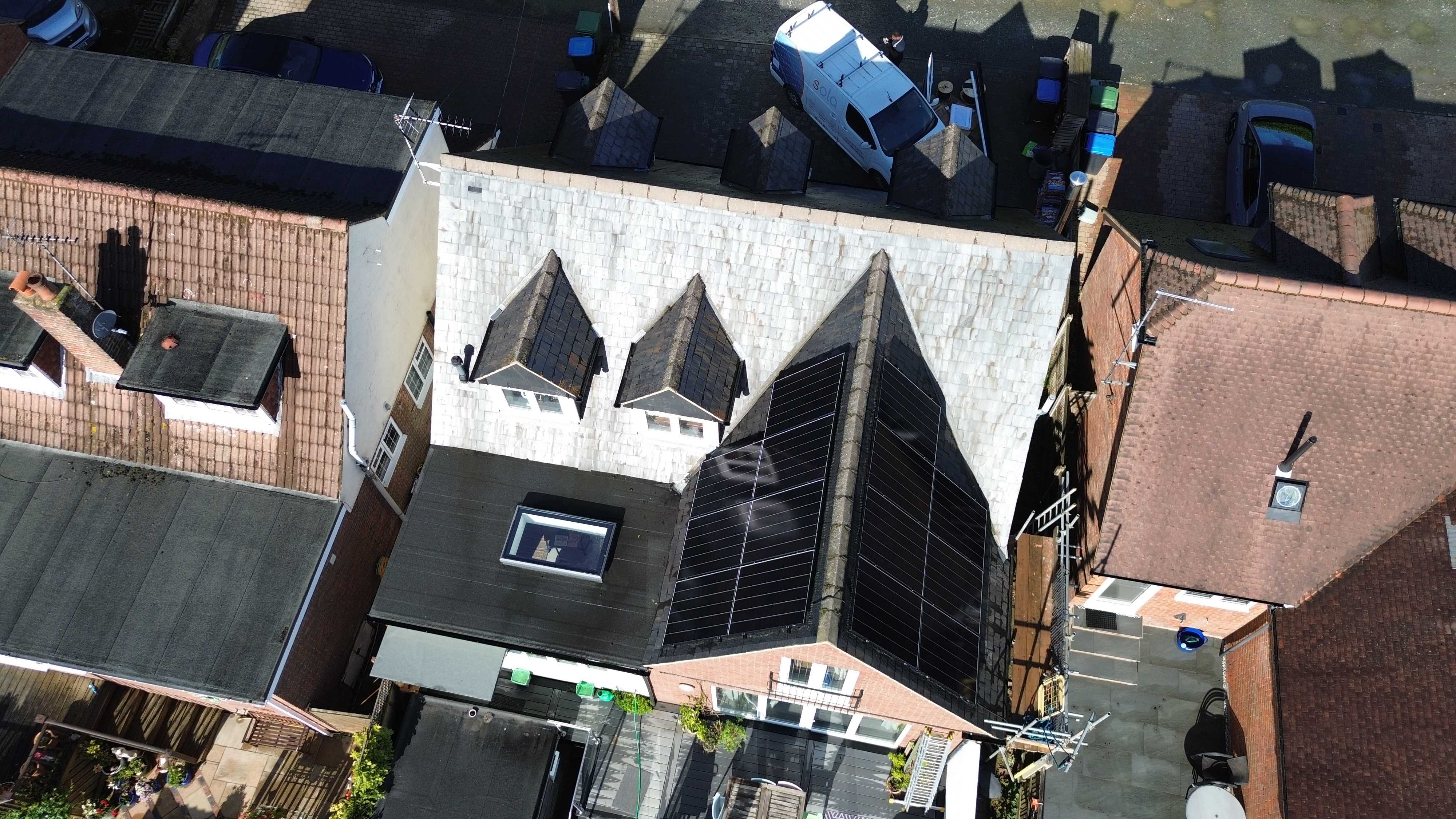
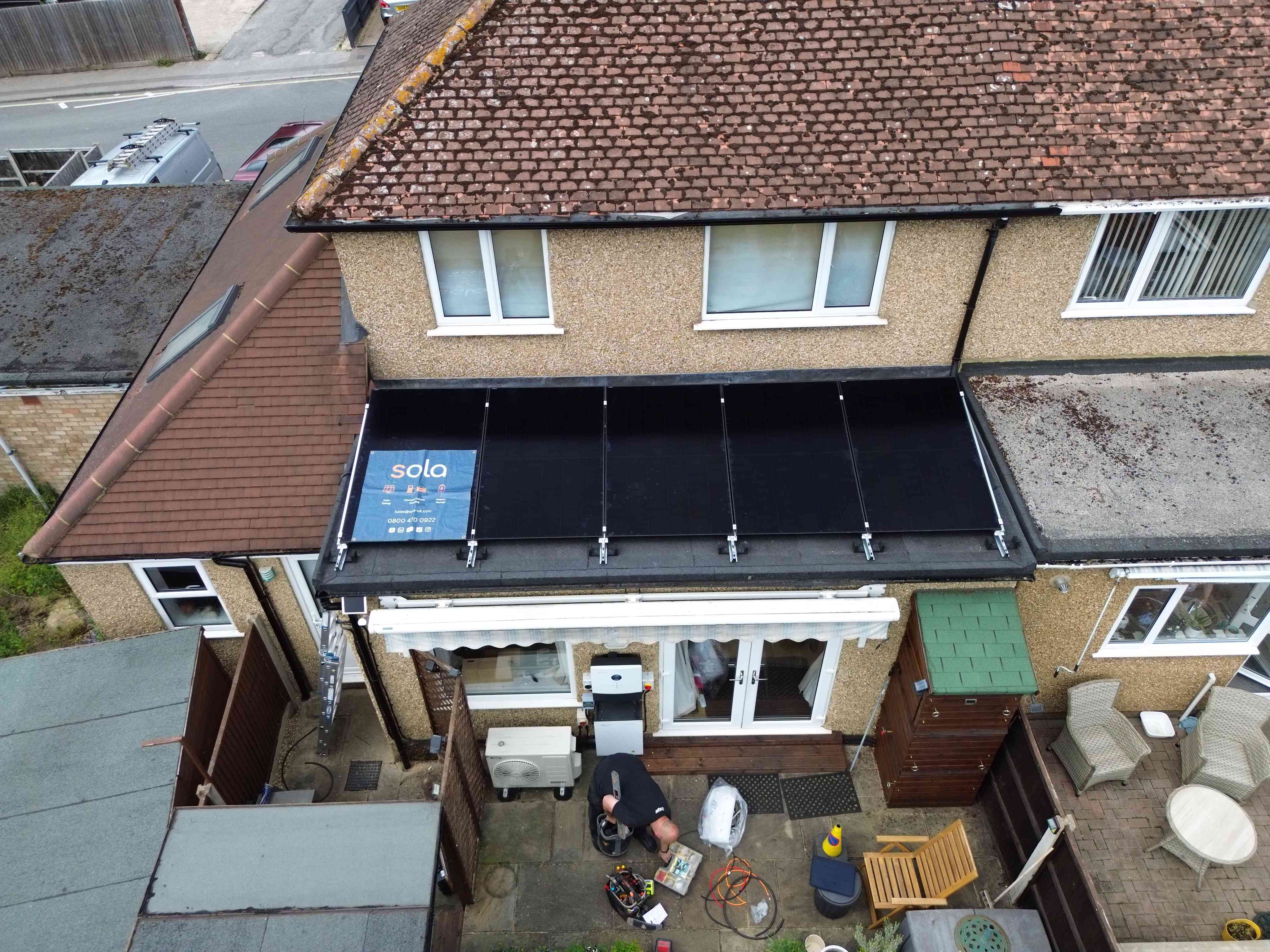
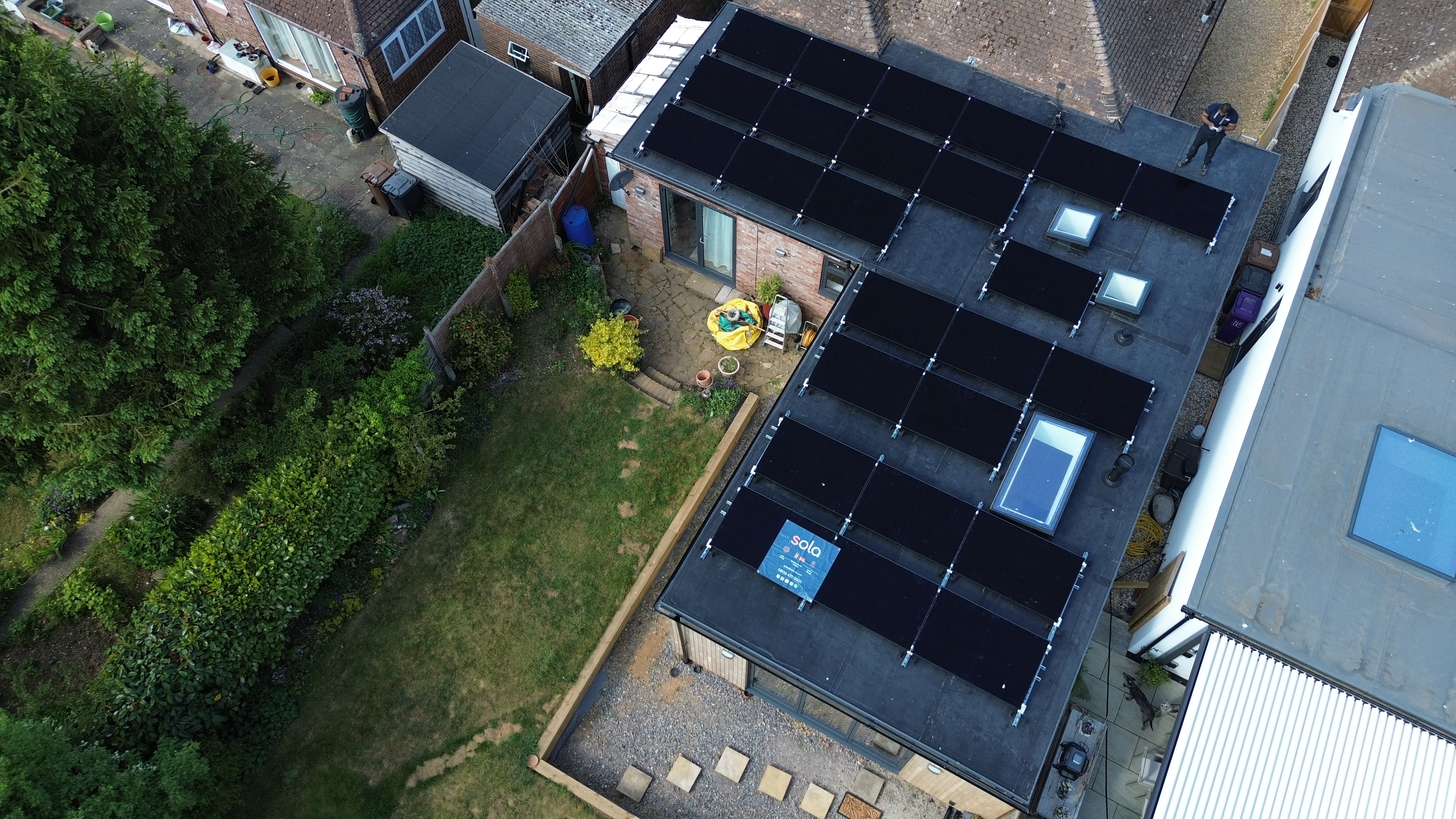
Houses account for 66.3% of Slough households. Scaling the PVGIS results in proportion to system size gives about 1,030kWh per kWp for a south-facing roof and about 813kWh per kWp for an east-west split. Using AIKO 485W all-black panels, that works out as follows:
| AIKO 485W panels | System size | South-facing estimate | East-west estimate |
| 6 | 2.91kWp | about 3,000kWh | about 2,370kWh |
| 8 | 3.88kWp | about 4,000kWh | about 3,150kWh |
| 9 | 4.37kWp | about 4,500kWh | about 3,550kWh |
| 12 | 5.82kWp | about 6,000kWh | about 4,730kWh |
Which row fits depends mainly on the usable area of your roof slopes. Dormers, chimneys, roof windows and hips all reduce usable space, and a survey measures what is left.
Flats and rented homes: someone else decides
Flats of all kinds account for 33.6% of Slough households, and tenure matters too. In Census 2021, 48.5% of households owned their home, 30.7% rented privately and 19.6% rented socially. If you rent, your landlord would normally need to agree to and arrange the work. In a block of flats the roof is often controlled by the freeholder or a management company, so that is the first conversation to have.
What each kWh is worth: using it or exporting it
A kWh your panels generate is worth different amounts depending on where it goes.
- Used at home, it replaces electricity you would otherwise buy. Under Ofgem's price cap for 1 October to 31 December 2026, the average electricity unit rate for Direct Debit customers in England, Scotland and Wales is 26.32p per kWh. Your own rate depends on where you live and how you pay.
- Exported, it earns a Smart Export Guarantee (SEG) tariff. Suppliers set their own SEG rates, which must always be above zero. Outgoing Octopus, for example, pays 12p per kWh and is a variable tariff, so the rate can change. SEG payments require an MCS-certified installation, and Octopus also needs a smart meter that can send half-hourly export data.
Applying those two prices to the PVGIS estimates gives the two extremes:
| Array | All used at home (26.32p) | All exported (12p) |
| South-facing 4kWp, 4,120kWh | about £1,084 | about £494 |
| East-west 4kWp, 3,252kWh | about £856 | about £390 |
Your real figure will usually sit between the two, because some generation happens when nobody at home is using much power. Standing charges, which average 54.83p a day for Direct Debit customers under the same cap, are paid whichever way the electricity goes. You can compare suppliers' export rates in our SEG calculator.
One way to move towards the higher column is to store daytime surplus for the evening. We install Tesla Powerwall 3 (13.5kWh of storage, 11.5kW continuous output) and SigEnergy battery systems, and our home battery storage page has more detail.
What to do next
- Check which way your roof slopes face. South, east and west all generate; the estimate is what changes.
- Check your planning position. Slough has five conservation areas, solar on a listed house is not permitted development, and parts of the SL1 to SL3 postcode districts fall in the Buckinghamshire or Windsor and Maidenhead council areas.
- Find 12 months of electricity bills, so a quote can be compared with what you actually use.
- Ask every installer for a generation estimate for your actual roof slopes, and whether your system can connect under SSEN's G98 process (up to 16A per phase, which is 3.68kW on a single-phase supply) or needs an application first.
One date worth knowing: domestic solar panels and batteries carry 0% VAT until 31 March 2027, then 5%. When you are ready, SOLA UK can survey your roof and quote; call 0800 470 0922.