Does the WGC Estate Management Scheme Apply to Commercial Solar?
Yes, if the premises sit inside the scheme area. The Estate Management Scheme controls external alterations, not just houses — and it sits alongside planning permission rather than replacing it.
Does the WGC Estate Management Scheme Apply to Commercial Solar?
Yes, where the premises fall inside the scheme area. The Estate Management Scheme in Welwyn Garden City is a control on external alterations, and it names solar panels among the roof works that need consent. It is not a domestic-only planning rule, and a commercial roof does not escape it by being commercial.
The more common mistake is the other one, though: assuming that because planning permission is not needed, nothing else is.
Two consents, not one
The scheme sits alongside planning permission rather than replacing it. An installation can be permitted development for planning purposes and still require EMS consent before work starts. Clearing one does not clear the other, and the two are decided separately.
The scheme also does not cover the whole town. It covers most of it, but not every address, which makes the first step on any WGC roof the same regardless of building type: establish whether the address is inside the scheme area before anyone designs a layout or prices a programme.
What the policy actually says
The scheme publishes four numbered policies — EM1 Extensions and Alterations, EM2 Erection of New Buildings, EM3 Soft Landscaping and EM4 Hard Landscaping — plus an additional policy covering Energy Efficiency and Other Roof Alterations. Solar is decided under that last one.
Its criteria are about siting rather than hardware:
1. The alteration must be sited on the rear or side roof slope, and sited to minimise the effect on the external appearance of the building.
2. Seen from any surrounding public vantage point, it must not have a detrimental impact on the character and appearance of the street scene, or on the wider amenities and values of the area.
3. The principal roof slope may be acceptable where, in the judgement of the case officer, the design of the property or the character of the area means there is no detrimental impact.
4. The decision maker weighs the environmental benefits of the energy-efficiency measure against its visual impact.
Point three is the one worth reading twice. The front slope is not banned outright. It is the harder application, and on a commercial unit it is rarely necessary, because the large rear and side planes usually carry the whole system anyway.
What a compliant layout looks like in practice
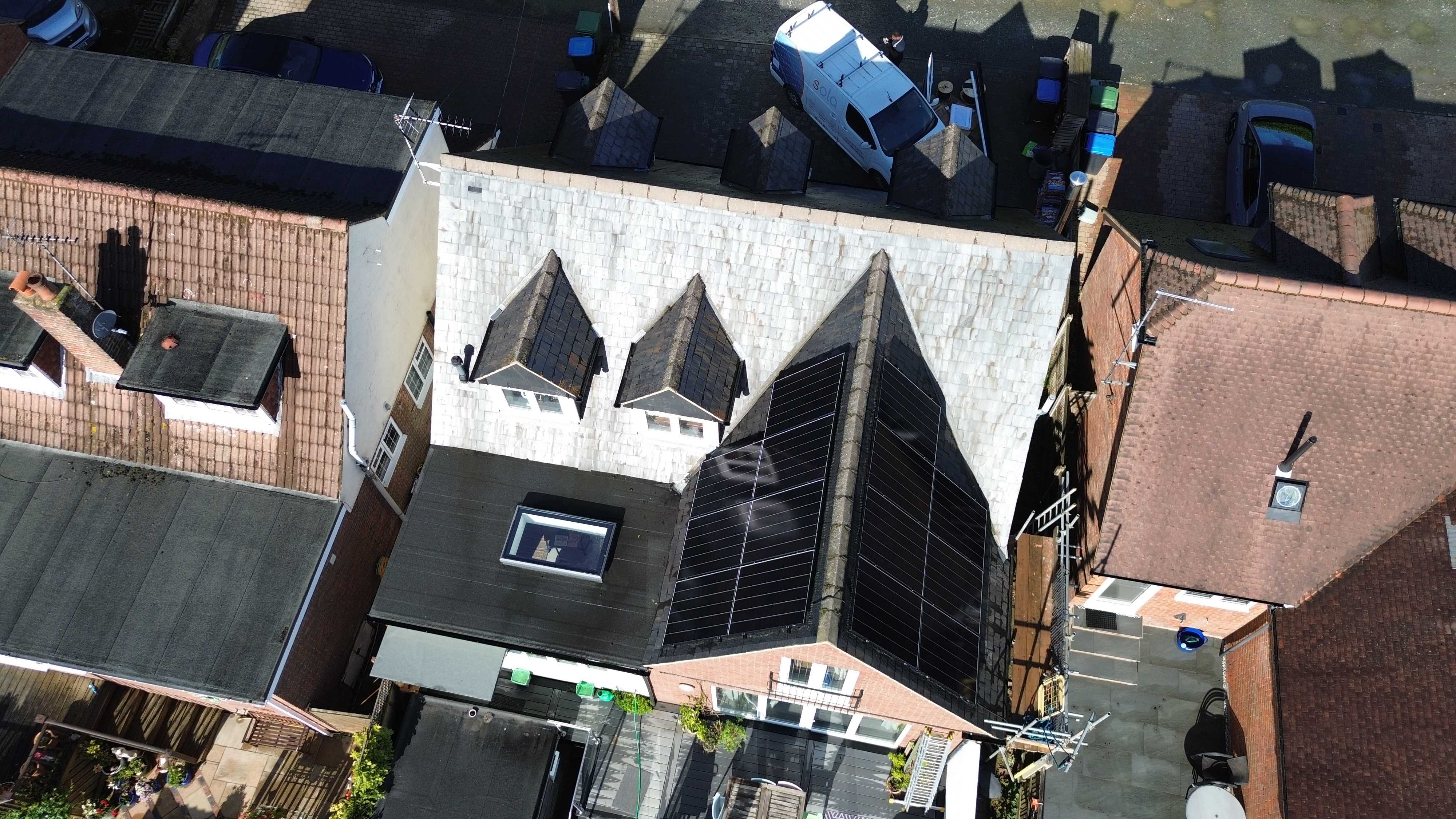
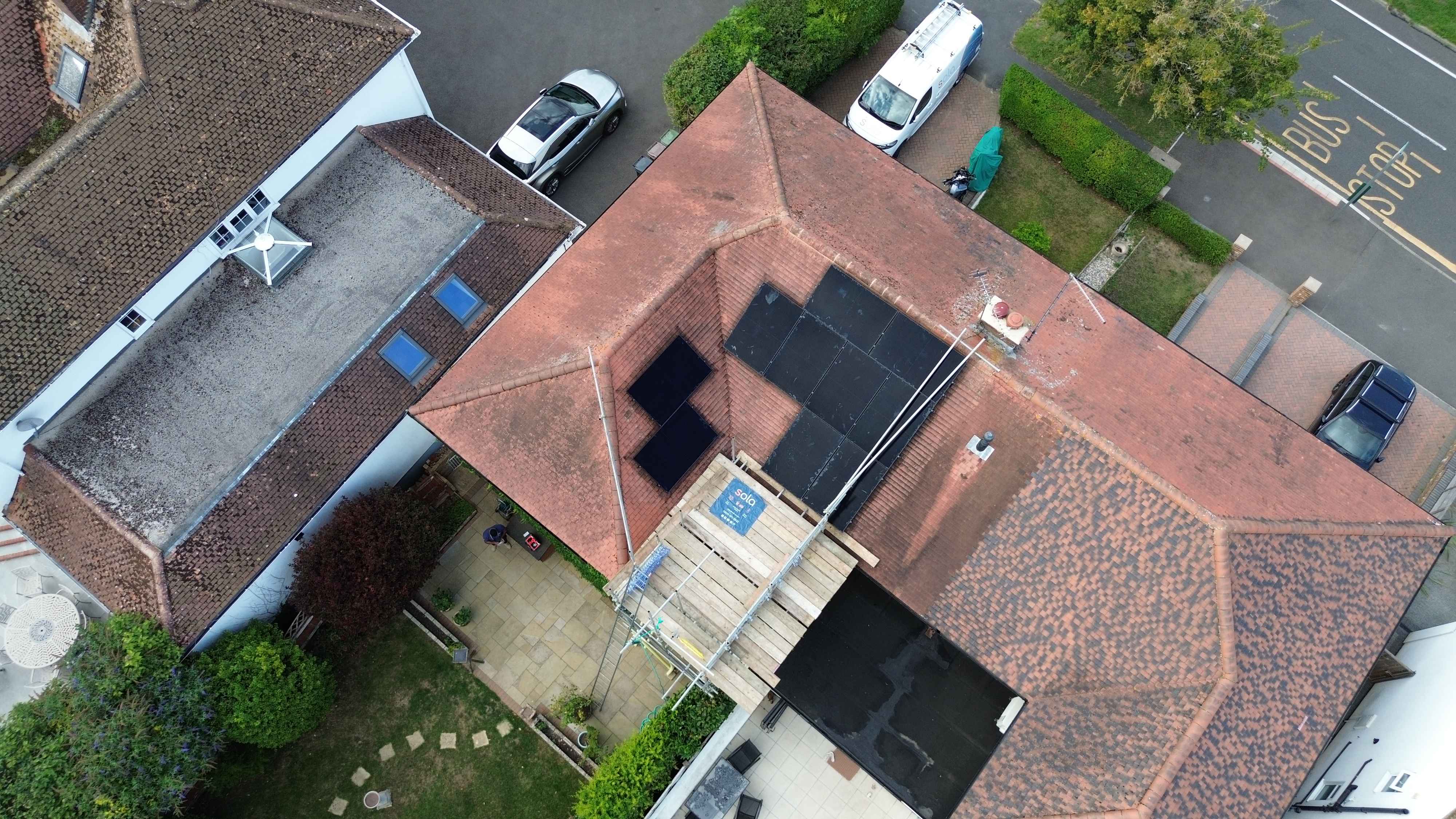
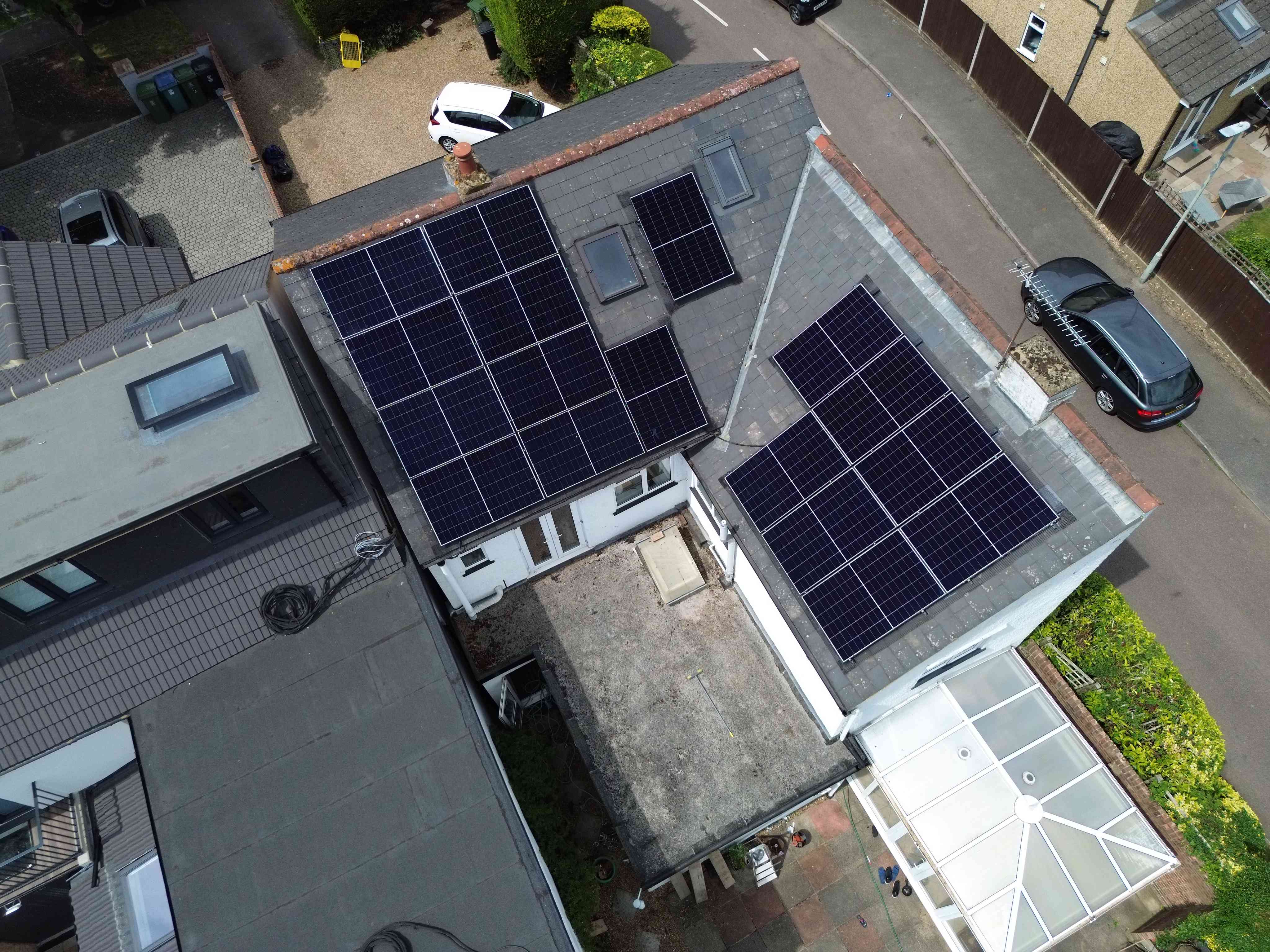
A 2025 scheme decision for an address on Knightsfield gives a useful picture of how those criteria read on a real roof: thirteen panels confined to the rear roof slope, split into two groups flanking the existing flues, with the array pulled in from the eaves, the ridge and the gable edges.
That is the pattern to design towards. An array set in from the edges and broken around existing roof furniture is arguing with the policy rather than against it.
What changes when the roof is commercial
The scheme is the same. Three things around it are not.
Grid connection. Most commercial roofs here exceed the G98 threshold of 16 A per phase — roughly 3.68 kW single-phase or 11.04 kW three-phase. Above that the route is a G99 application to UK Power Networks, approved before installation rather than notified within 28 days after commissioning. That is a programme item, not a form. MCS scope. The MCS scheme ends at 50 kWp. A large warehouse roof can pass that, at which point the installation sits outside MCS, which has consequences for certification and for the Smart Export Guarantee that are better understood at design stage than discovered later. VAT and allowances. The zero rate applies to domestic installations and runs to 31 March 2027 before reverting to 5%. A commercial roof is standard-rated, though normally recoverable for a VAT-registered business. The allowance that matters is capital allowances: solar is special-rate expenditure, so it goes to the annual investment allowance or the 50% first-year allowance, never to full expensing. Confirm your own position with your accountant before it goes into a business case.Which roofs are worth modelling
The buildings with both daytime load and roof area. In this town that points at the industrial and warehouse stock on and around Tewin Road, and the office and campus floorspace at Shire Park, rather than town-centre retail frontage.
The reason is self-consumption. A unit used on site displaces a purchased unit, and DESNZ put non-domestic electricity at 24.51p per kWh including the Climate Change Levy for the second quarter of 2026, whereas an exported unit earns an export rate instead. A business running plant through the middle of the day therefore gets a materially different answer from one that is busy at seven in the evening, on an identical roof.
If you are weighing up commercial solar in Welwyn Garden City, that page sets out the planning, grid, VAT and capital-allowance position in one table, and what the local building stock supports. We prepare and submit the EMS application as part of the project.