Solar Panels on Listed and Period Homes in Hertford
When Hertford's listed and period homes need consent for solar, what the conservation area rules allow, the Article 4 position and practical roof options.
Solar Panels on Listed and Period Homes in Hertford
East Herts District Council's appraisal of the Hertford conservation area counts nearly 280 listed building groups inside it, alongside streets of 19th and early 20th century terraces. If you own one of those homes, the real question is which of three separate tests applies. Is it listed? Is it inside the conservation area? And has an Article 4 Direction removed permitted development rights on your street? For design and fitting, our page for solar panel installers in Hertford explains what we install and how the local rules apply.
The three tests at a glance
| Your situation | What applies | Before work starts |
| The house is listed, at any grade | Outside the Part 14 Class A solar rights | Planning permission, plus listed building consent where the works affect its character |
| In the conservation area, not listed | Class A rights with conservation area limits | Keep panels off a wall, balcony or roof enclosure fronting a highway; apply for prior approval for a flat roof |
| Covered by an Article 4 Direction | Rights removed for the classes it names | Check whether solar is one of them and apply if so |
| None of these | Class A permitted development | Stay within the size limits and notify the network operator |
Listed homes: consent first
The appraisal lists three grade I buildings in the conservation area, Hertford Castle, Shire Hall at 15 Fore Street and the Church of St Leonard, and 23 buildings at grade II*. Whatever the grade, a listed house sits outside the solar permitted development rights in Part 14 Class A of the General Permitted Development Order, and so does any building within its curtilage, so a roof-mounted system will normally need planning permission.
Listed building consent is a separate requirement. Section 7 of the Planning (Listed Buildings and Conservation Areas) Act 1990 prohibits unauthorised works to a listed building:
for its alteration or extension in any manner which would affect its character as a building of special architectural or historic interest
Treat consent as the starting assumption and speak to East Herts early. The appraisal also notes that structures within the curtilage of a listed building, if they are pre-1948, are subject to the same controls as listed buildings, so an old coach house or garden wall may be treated as part of the listing.
Options worth discussing for a listed home:
- A later outbuilding. Panels on a garage or garden building within the curtilage still fall outside Class A, but a building put up after 1948 may not be subject to the same listed building controls.
- A hidden slope or valley. A slope that cannot be seen from the street or other public spaces.
- In-roof panels. Integrated systems sit within the roof plane, but they replace part of the roof covering, which on a listed building is itself an alteration the council will weigh.
Period homes in the conservation area
The Hertford conservation area was first designated in 1967, revised in 1981 and further amended in 1996, and the council adopted its appraisal and management plan in March 2017. Many of the unlisted terraces it describes are 19th century yellow brick with slate roofs and prominent chimneys.
For an unlisted house inside the boundary, the rules changed on 27 August 2026, when S.I. 2026/896 came into force. Class A now restricts solar equipment in a conservation area only where it is installed on:
a wall, balcony or roof enclosure which fronts a highway
Roof slopes are not on that list, and that includes a slope facing the street. On a pitched roof, panels must not protrude more than 0.2 m from the roof slope or sit higher than the highest part of the roof, excluding chimneys. On a flat roof, they must not sit more than 0.6 m above the highest part, and in a conservation area a flat-roof array needs an application for a prior approval determination before work starts.
If you are reading older council guidance, check it against the current order. The East Herts leaflet for owners and occupiers describes the restriction as solar on wall elevations visible from a public place, which is not how the amended order is worded.
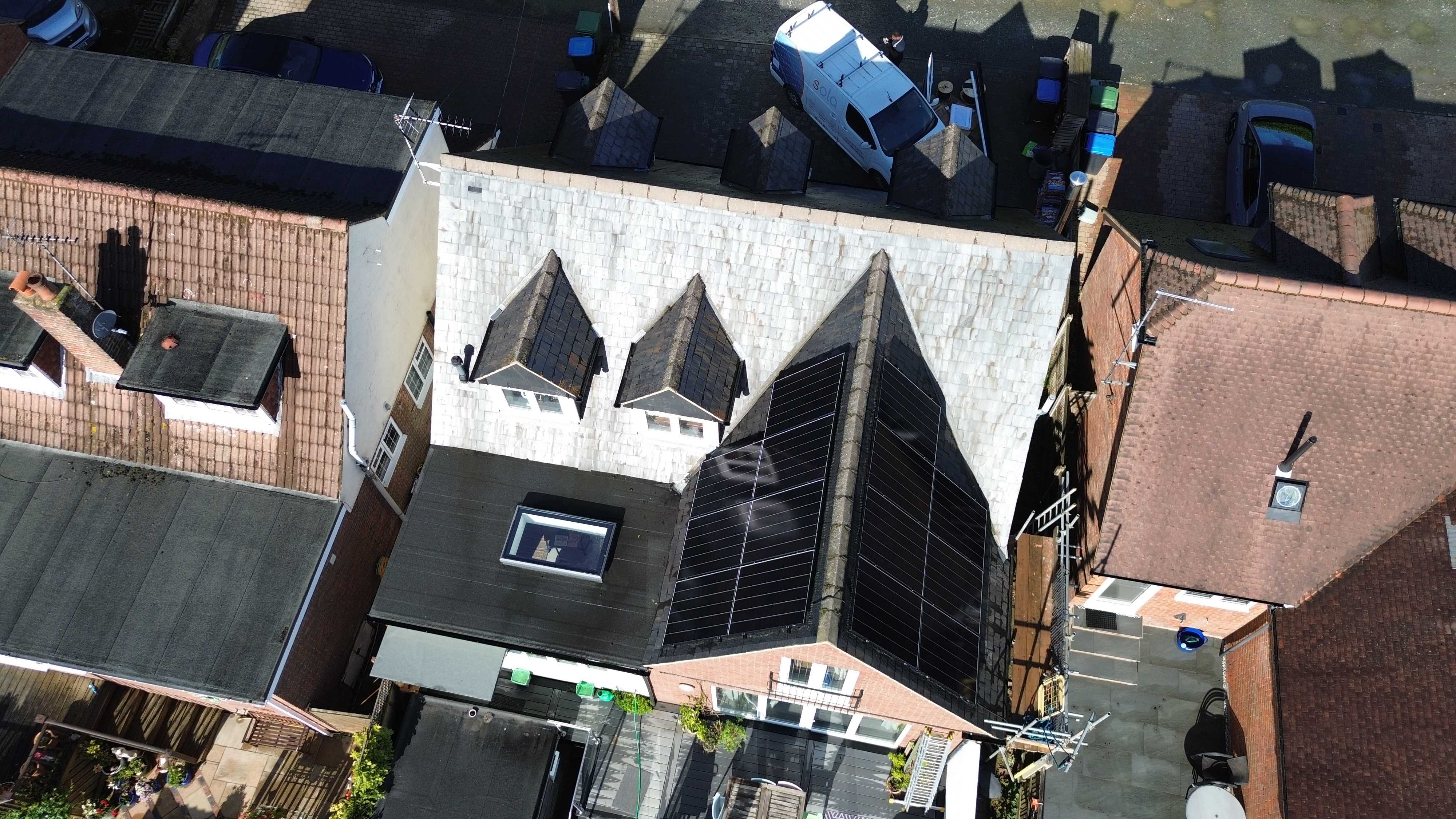
Appearance still matters inside the boundary even where no consent is needed. A neat, rectangular array of all-black panels, such as the AIKO 485W modules we fit, keeps the roof line simple.
Article 4 Directions: the Hertford position
An Article 4 Direction is the one tool that can remove roof-slope rights on particular properties, and East Herts has planned to use them more widely. A report to the council's Executive in February 2018 set out a four-phase programme for Directions across its conservation areas, with Hertford as phase 2, described as very large at 3,827 properties, and the Executive authorised further Directions for all of the district's conservation areas.
Bishop's Stortford's pilot householder Direction, confirmed on 15 November 2017, withdrew classes from Parts 1, 2 and 11 of the order, such as roof alterations, porches, chimneys and exterior painting. Part 14 solar was not in its schedule.
We have not found a confirmed Article 4 Direction for Hertford houses on the council's website, but that is not proof that none exists. A later council report, in December 2019, said Directions had already been applied in some of the district's conservation areas, mostly around historic high streets, without naming them. The 2018 report notes that Directions become a local land charge, so for a specific address ask the East Herts planning team, or run a local land charges search, before relying on permitted development.
Practical roof options and what they generate
Keeping panels discreet often means using a rear slope that does not face south. PVGIS, the European Commission's solar model, gives these figures for central Hertford:
| Roof option (4.5 kWp, 14% system losses) | Modelled output per year |
| South-facing slope, 35 degrees | 4,624 kWh |
| East-facing slope, 35 degrees | 3,699 kWh |
| West-facing slope, 35 degrees | 3,601 kWh |
| South-facing frame, 10 degrees | 4,177 kWh |
An east or west slope produces about a fifth less than due south. A battery lets you move more of that generation into the evening; our battery storage service covers the SigEnergy and Tesla Powerwall 3 systems we fit. Adding a battery to solar is likely to take a system above 16 A per phase, in which case a G99 application goes to UK Power Networks before installation, rather than a G98 notification within 28 days after commissioning.
What to do next
- Check whether the house is listed on Historic England's National Heritage List for England.
- Check whether it is inside the Hertford conservation area using the East Herts online map.
- Ask East Herts planning whether any Article 4 Direction applies to the address.
- Get a survey that models your actual slopes, including east and west options, and compare quotes from MCS-certified installers. You can read about our residential solar installations first.
The 0% VAT rate on domestic solar panels and batteries runs until 31 March 2027, then 5%, but planning checks are not worth skipping to beat that date; a smaller rear-slope system, or waiting for consent, beats a rushed installation.