Home Battery Storage in Hertfordshire: 2026 Buyer's Guide
A Hertfordshire installer's breakdown of home battery storage in 2026 — costs, brands, payback times, and how to pair batteries with solar and EV.
Home Battery Storage in Hertfordshire: 2026 Buyer's Guide
Home battery storage has crossed a tipping point. In 2025, UK residential battery installations grew by 34% year-on-year according to Solar Energy UK, and Hertfordshire is tracking ahead of the national average. If you've already got solar panels — or you're planning a combined system — this guide gives you the real figures and context you need to make the right decision in 2026.
How Battery Demand Is Shaping the Regional Market
The growth pattern in Hertfordshire mirrors what we're seeing across the South East, but there are local nuances worth understanding. St Albans, Harpenden and Welwyn Garden City have seen particularly strong uptake because of the high proportion of detached homes with suitable roof space and a demographic that's willing to invest over a longer horizon.
Across the wider South East, installers are reporting that around 60% of new solar enquiries now include battery storage from the outset — a significant shift from 2023, when most customers bolted storage on later or not at all. Midland Solar in the West Midlands has reported a similar pattern in their region, with the West Midlands now seeing battery enquiries outpace standalone solar installs for the first time. That regional convergence tells us the economics are shifting nationally, not just in Hertfordshire.
Electricity prices are the driving force. With the Ofgem price cap keeping household rates above 24p/kWh through most of 2025 and 2026, the incentive to store and self-consume solar rather than export it at 15p/kWh has never been stronger. The spread between export and import rates — roughly 9-10p/kWh in most cases — is what determines battery payback, and that spread has been stable enough to model reliably.
What Does a Battery System Actually Cost in 2026?
Costs have dropped roughly 18% since 2023. Here's what Hertfordshire homeowners should expect to pay for a complete installed system:
| Battery Model | Usable Capacity | Installed Cost (incl. VAT) | Warranty |
| SIG Energy All-in-One 2 | 13.5 kWh | £7,200 – £8,800 | 10 years |
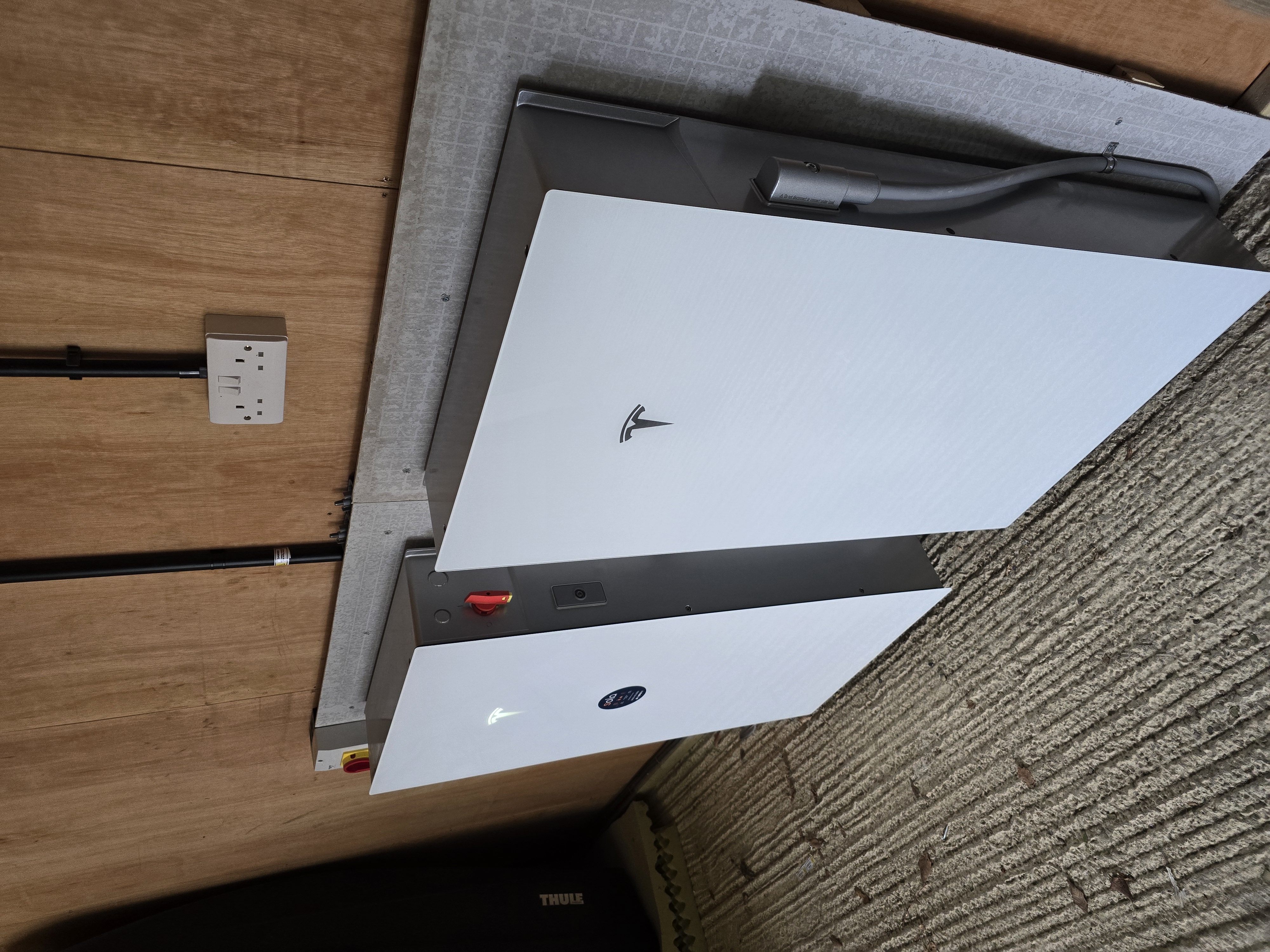
| Tesla Powerwall 3 | 13.5 kWh | £9,000 – £10,500 | 10 years |
| Fox ESS HV2600 | 5.2-20.7 kWh | £4,800 – £8,500 | 10 years |
| Solax Triple Power | 5.8-23.2 kWh | £4,700 – £8,000 | 10 years |
Battery storage qualifies for 0% VAT when installed alongside solar panels — a saving of roughly £1,000-£1,500 on most systems. Standalone battery retrofits (added after the original solar install) also qualify for 0% VAT as of 2023 legislation, which removed the previous requirement to install simultaneously.
Combined solar and battery system costs:A 5kW solar system paired with a 10kWh battery will typically cost £12,500 to £16,000 installed in Hertfordshire. Larger 8kW solar plus 13.5kWh battery combinations run from £16,000 to £21,000. These are complete MCS-certified systems including scaffolding, DNO notification, monitoring equipment and all labour.
Battery and Commercial Solar: A Different Calculation
The battery economics shift considerably for commercial applications. Commercial properties — small industrial units, larger offices, farm buildings — have different load profiles and often better justification for large-capacity storage.
EC Eco Energy for UK-wide commercial work has published useful benchmarks showing that commercial battery systems typically achieve 40-50% shorter payback periods than residential, primarily because commercial electricity rates are higher and the load profile (heavy daytime usage) aligns well with solar generation peaks. For Hertfordshire business owners considering battery storage, the commercial calculation often makes the residential one look conservative.For residential Hertfordshire homeowners, the key financial metric to focus on is self-consumption rate. A 5kW solar system without storage typically achieves 35-40% self-consumption (the proportion of generated energy used on-site). Add a 10kWh battery and that rises to 70-85%, depending on household size and usage patterns.
How Payback Works: Running the Real Numbers
Here's a worked example for a typical 4-bed detached home in St Albans, AL1:
Starting assumptions:- Annual electricity usage: 4,200 kWh
- Current import rate: 26p/kWh
- SEG export rate: 15p/kWh
- 5kW solar system generating 4,500 kWh per year
- Self-consumption: 38% = 1,710 kWh used on-site
- Export: 62% = 2,790 kWh exported
- Annual savings: (1,710 × 26p) + (2,790 × 15p) = £444 + £419 = £863/year
- System cost: £8,500
- Payback: 9.8 years
- Self-consumption rises to 80% = 3,600 kWh used on-site
- Export: 20% = 900 kWh exported
- Annual savings: (3,600 × 26p) + (900 × 15p) = £936 + £135 = £1,071/year
- Additional saving vs. no battery: £208/year
- Battery-specific payback: £6,500 / £208 = 31 years
This is where homeowners often get caught out. The battery doesn't always shorten the combined system payback — it increases total savings, but the battery unit itself may have a long payback when assessed in isolation. The real case for battery storage in Hertfordshire in 2026 is time-of-use tariff optimisation, not pure solar self-consumption maths.
The Tariff Opportunity: Octopus Flux and Intelligent Octopus
Battery economics change dramatically when you add time-of-use (TOU) tariffs to the equation. The Octopus Flux tariff allows battery owners to import cheap overnight electricity (typically 12-18p/kWh between 2am and 5am), store it, and either use it during peak periods or export it at inflated peak rates (up to 35p/kWh between 4pm and 7pm).
For a Hertfordshire home with a 10kWh battery, running a Flux-compatible system adds £400-£700 per year in additional financial benefit beyond simple self-consumption savings. That changes the combined solar-and-battery payback calculation materially:
Solar + battery + Flux tariff combined payback example:- Annual savings: £1,071 (self-consumption) + £500 (Flux trading) = £1,571/year
- Combined system cost: £15,000
- Combined payback: 9.5 years
With a 25-year system lifespan, that's 15+ years of net profit after payback. At current rates, around £23,000 in net financial benefit over the full system life.
How to Choose a Battery Installer in Hertfordshire
Battery storage installation requires additional competencies beyond standard solar. The installer must hold the right accreditations:
- MCS certification — mandatory for battery storage qualifying for 0% VAT and any grid-connected work
- Part P — electrical work in dwellings must be notified to Building Control; MCS installers handle this
- DNO notification — batteries above certain thresholds require DNO (UK Power Networks in Hertfordshire) application before installation
Questions to ask any battery installer before signing:
1. Are you MCS-certified for battery storage specifically, or only for solar?
2. Which battery brands do you install and why — are you tied to one brand?
3. Who handles DNO notification and G99 application if required?
4. What monitoring system do you provide and is it included?
5. What happens if the inverter fails outside warranty?
D&R Energy in Bristol maintains a useful public checklist for battery installer vetting — their standards checklist is worth reading even for Hertfordshire homeowners because the criteria are consistent nationwide.Regional Context: How Hertfordshire Compares
Hertfordshire sits in a strong position for battery ROI. The county has:
- Above-average solar irradiance (1,100-1,150 kWh/kWp/year) compared to the UK average of around 950 kWh/kWp/year
- High energy costs relative to national average, partly driven by SE England grid charging
- Excellent UK Power Networks infrastructure, meaning DNO applications are generally processed faster than in some northern regions
For comparison, CCS Heating & Renewables in Cornwall serve a region with even higher solar irradiance (1,200+ kWh/kWp/year), but also face more challenging DNO processes in some rural areas of the far South West due to grid capacity constraints. Hertfordshire's mature grid infrastructure is a genuine advantage for battery storage adoption.
EV Charging and Battery Integration: The Three-Way System
The most financially optimised home energy setup in 2026 is solar + battery + smart EV charger operating as a unified system. A compatible smart charger — Zappi, Ohme or myEnergi — will communicate with your battery inverter to prioritise solar charging of your EV, falling back to battery, and only drawing from the grid at off-peak rates.
The financial case for the three-way system is strong. UK homeowners driving 10,000 miles annually in an EV spend £300-£500 per year on home charging at standard rates. A smart solar-battery-EV setup can reduce that figure to near-zero in summer months and achieve 70%+ solar charging even in winter.
Leicester installer Energy Concerns has published detailed data on integrated solar, battery and EV charger systems — their performance figures from the East Midlands align closely with what we observe in Hertfordshire, giving useful cross-regional benchmarking for customers evaluating the full three-way system.What's Coming: Virtual Power Plants and Grid Services
Battery owners in Hertfordshire will increasingly be able to monetise their storage capacity beyond self-consumption and TOU tariffs. Virtual Power Plant (VPP) programmes — already running commercially via Octopus Energy and Kaluza — pay battery owners to make their storage capacity available to the grid during demand peaks.
Current VPP payments are running at £100-£250 per year for a 10kWh system, with higher payments likely as the UK accelerates grid storage targets. This isn't a primary reason to invest in battery storage today, but it's a genuine upside that reduces effective payback when included in a full system lifetime calculation.
Frequently Asked Questions
Can I add a battery to an existing solar system in Hertfordshire?Yes. Most modern hybrid inverters and AC-coupled battery systems can retrofit to existing solar installations. The retrofit cost is typically £500-£1,000 higher than installing alongside a new solar system due to additional AC wiring work.
How long does a home battery last?Most residential lithium batteries carry 10-year warranties. LFP (lithium iron phosphate) chemistry batteries — which include SIG Energy, Tesla Powerwall and Fox ESS models — are rated for 6,000+ charge cycles, equating to 15-20 years of real-world use at normal cycling rates.
Will a battery power my home during a blackout?Only if specifically configured with backup functionality. Not all battery inverters support off-grid/backup mode. Tesla Powerwall 3 and SIG Energy systems do include backup as standard. Others require an optional gateway. Confirm with your installer before purchase.
Is battery storage covered by the SEG?No. The Smart Export Guarantee covers electricity exported from solar panels, not battery-only exports. You can export solar energy that has been stored in a battery, but you cannot export grid electricity stored overnight and claim SEG payments — that would constitute meter manipulation.
How many batteries do I need?For most Hertfordshire homes (3-4 bedrooms, 3,500-4,500 kWh annual use, 4-6kW solar), a single 10-13.5kWh battery provides optimal self-consumption. Adding a second battery is worthwhile if you have an EV, run a home office with high daytime loads, or are targeting near-complete grid independence.
Summary and Next Steps
Home battery storage makes financial sense for most Hertfordshire homeowners with solar panels in 2026, particularly when paired with a compatible time-of-use tariff. The strongest financial case is for:
- Homes with existing 4kW+ solar systems looking to increase self-consumption
- Households with EVs who want to maximise solar charging
- Homeowners on or eligible for Octopus Flux or Intelligent Octopus
- Properties with high evening electricity usage (working families, home offices)
The weakest case is for retirees who are home all day, as they already capture most of their solar generation directly — battery additions provide diminishing returns in that scenario.
For a free, no-obligation battery storage assessment for your Hertfordshire property, contact our team or call us directly. We'll review your current usage data, existing system (if any), and give you an honest projection with no sales pressure.